AI Readiness for Sustainability Leaders: How to Assess Your Maturity and Set a Realistic AI Strategy
TL;DR
Most sustainability teams are under pressure to “do something with AI” without a clear view of their current stance, readiness, or maturity. By clarifying your AI posture, assessing where you sit on a simple readiness and maturity framework, and reading the hype cycle as a timing tool, you can prioritise a small number of high‑value, low‑regret moves.
Over the next 90 days, focus on three things: align leadership on your stance, run a pragmatic readiness assessment, and design a sustainable AI roadmap with guardrails that protect your climate and ESG ambitions while creating real operational value.
Why Your AI Stance Matters for Sustainability
Before you sign another AI contract or launch a pilot, ask: what stance are we actually taking on AI as a sustainability function? Your stance shapes where you place bets, how fast you move, and which risks you accept.
A simple way to see this is through four AI stance types, defined along two axes: whether you use AI selectively or holistically, and whether you focus on expanding strategically or optimising internally. These are not maturity levels; they are strategic choices, and different business units – including sustainability, can sit in different boxes and move as context shifts.
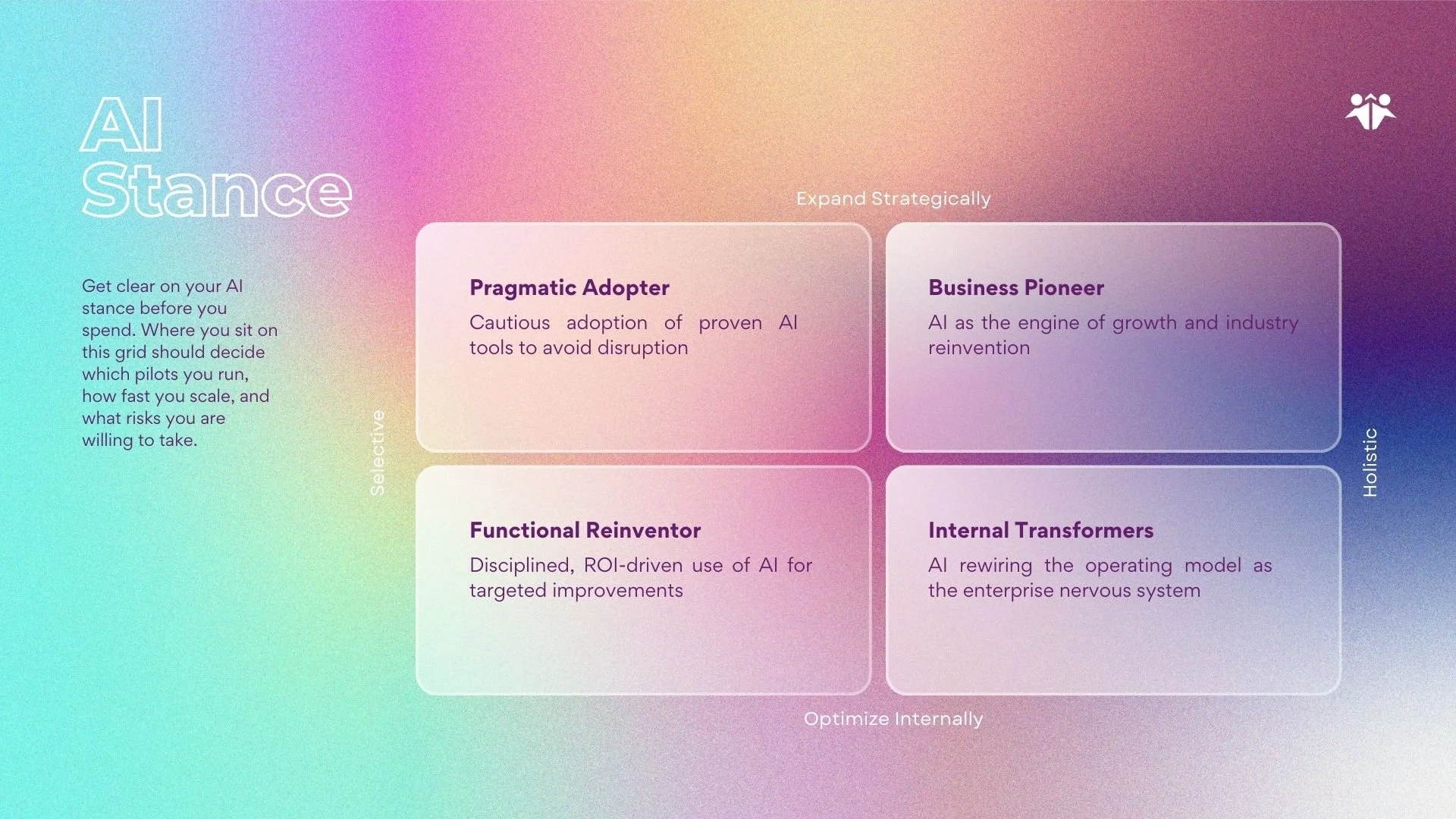
Based on McKinsey, Boards in the Age of AI Webcast
Pragmatic adopters (Selective / Expand Strategically)
Cautious users of proven tools. In sustainability this looks like AI for reporting support, basic carbon accounting, or drafting, with tight control of disruption. Upside: lower risk. Risk: missed step‑change opportunities.
Business pioneers (Holistic / Expand Strategically)
See AI as an engine of growth and reinvention. Sustainability teams here use AI to reshape products, services, and value chains. Impact can be high, but so are demands on governance, ethics, and resilience.
Functional reinventors (Selective / Optimize Internally)
ROI‑driven improvers. You target specific processes such as data collection, assurance workflows, or supplier engagement. This is often where sustainability lands when the wider leadership is cautious: value is proven, but within a defined scope.
Internal transformers (Holistic / Optimize Internally)
Use AI to rewire the operating model, making it the “nervous system” of the enterprise. For sustainability, that means near‑real‑time carbon intelligence and AI embedded into finance, operations, and planning. It requires strong foundations in data protection, cybersecurity, IP and vendor management.
For boards and sustainability committees, these stance types turn a fuzzy topic into a concrete discussion: Where is the value? What needs to change? How much is this costing us, and what impact is it driving? A clear stance lets you set escalation triggers (when a pilot comes to the board), scaling thresholds, and expectations for protections around vendors, data, and AI workloads.
Your stance also affects your competitive position. A “pragmatic adopter” today can find its moat eroding quickly if peers deploy AI more holistically across the value chain, while jumping to “pioneer” or “internal transformer” without ethics and sustainable AI guardrails can damage trust and climate goals. Clarifying your stance gives you a strategic anchor: it helps you choose the right initial use cases and decide where AI should responsibly amplify, not undermine, your sustainability ambitions.
A Simple AI Readiness Framework for Sustainability Leaders
To move from one‑off experiments to real impact, sustainability leaders need a clear way to gauge how ready their organization is to use AI responsibly and at scale. This AI readiness framework is designed for enterprises, with a particular focus on sustainability functions that must work closely with digital and data teams.
1️⃣ Clarify the target
Be explicit about who you are assessing: This readiness framework can be applied across the whole enterprise, a specific business unit, or the sustainability function and its key partners (e.g., finance, operations, procurement). Taking a wider view prevents a “technology‑only” view and keeps climate and ESG outcomes in scope.
2️⃣ Identify Core Dimensions: Break AI readiness into a small set of dimensions that matter most for your organization. Common dimensions include:
Strategy and Governance: Including responsible and sustainable AI guardrails encompassing privacy, cyber threats and IP considerations
Infrastructure: From supply chain, materials, and basic computing power to more intelligent, efficient computing clusters that consider chips, storage, networking and energy use.
Data Ecosystem and Pipelines: Covering core ESG, carbon, and messy value‑chain data
Models and Interoperability: Choosing the right‑sized models (large vs. small) and balancing hallucinations, latency, security and cost, while using open standards and APIs so tools can talk to each other.
Talent: Mix of technical AI skills and commercial / sustainability skills so teams can translate models into real decarbonisation and reporting outcomes.
3️⃣ Define Clear Levels: Establish distinct levels of AI readiness. The five stages below are commonly used:
Stage 1: Early Watchers - Awareness of AI, but little activity
Stage 2: Experimenters - Active but fragmented AI experimentation
Stage 3: Emerging Integrators - Limited AI integration
Stage 4: Scalers - Significant AI integrating and scaling
Stage 5: Embedded Leaders - AI fully integrated into operating model
4️⃣ Develop Measurable Criteria & Metrics: Under each dimension and level, define observable criteria such as: existence of an AI and sustainability governance policy, percentage of key sustainability processes supported by AI, data coverage and quality scores, or share of team members trained on AI tools. Where possible, attach simple metrics so you can track progress over time.
5️⃣ Create Assessment Tools: Translate the framework into a few practical tools you can use with colleagues: for example, a short self‑assessment for sustainability and business unit leads, a workshop checklist to score each dimension, and a simple dashboard that visualises the current level by function. Combine qualitative input from discussions with sustainability, IT, data, risk and HR leaders with quantitative indicators pulled from existing systems (such as training records, system usage data, or process metrics), so the picture reflects both lived experience and hard data.
6️⃣ Establish Benchmarking & Best Practices: As you assess different parts of the organization, build internal benchmarks: what does “good” look like in your context, and which teams are furthest ahead? Where useful, draw on external benchmarks from your industry or peers to calibrate ambition and avoid reinventing the wheel.
7️⃣ Iterate and Adapt: The framework must be dynamic. AI, regulation, competitive moats, and sustainability expectations are moving quickly. Treat the framework as a living tool: review it at least annually to incorporate new technologies, changing ethical standards, regulatory developments, and lessons learned from your own pilots and programmes.
-
There is one more question sustainability leaders need to ask: ready for what kind of AI? Technical and organisational readiness are only half the story. The choices you make across the AI lifecycle, from hardware and data centres to models, applications, and end‑of‑life, all carry environmental and social impacts.
This is where the Sustainable AI Stack (<—Found on my LI) comes in. It reminds you that readiness is not just about having data pipelines or copilots in place; it is also about how you manage supply chain and materials, physical infrastructure, data ecosystems, AI platforms and models, applications and deployment, in‑use governance, and lifecycle management. By mapping your AI readiness dimensions onto these seven layers, you can spot where new AI projects may increase emissions or risk, and design interventions that keep climate and ESG goals front and centre as your AI maturity grows.
How AI Maturity Interacts with the Hype Cycle
When boards talk about AI, two curves are at play: the hype cycle (expectations in the market) and your AI maturity curve (what your organization can actually deliver today). Problems arise when those two curves drift too far apart. In many corporates, expectations are near the Peak of Inflated Expectations: vendors, media and internal champions are promising transformation, and early pilots show flashes of potential.
But internally, most organizations are still at Stage 1–3 on the maturity curve: awareness, fragmented experiments, and limited integration into real workflows. The risk is predictable: too many proofs‑of‑concept, not enough value, and a leadership team that swings from enthusiasm to fatigue.
For sustainability leaders, this gap matters twice over. First, it can pull scarce budget and attention into eye‑catching pilots rather than the boring but essential work of data, infrastructure and governance. Second, it can push AI into sensitive sustainability domains (targets, disclosures, risk assessments) before safeguards, skills and decision‑rights are in place. The result is higher risk with limited impact.
A more useful way to read the hype cycle is as a timing tool rather than a prediction machine. On the way up the curve, the key questions are: Could we do it? Would we do it? And, is the technology technically viable and strategically relevant for us?
Around the Trough of Disillusionment and Slope of Enlightenment, the crucial question becomes: Should we do it here, now, in this part of the business? That is where AI maturity comes in: the same technology might be appropriate in a Stage 4 function that has solid data and governance, but premature in a Stage 1 team that is still firefighting spreadsheets.
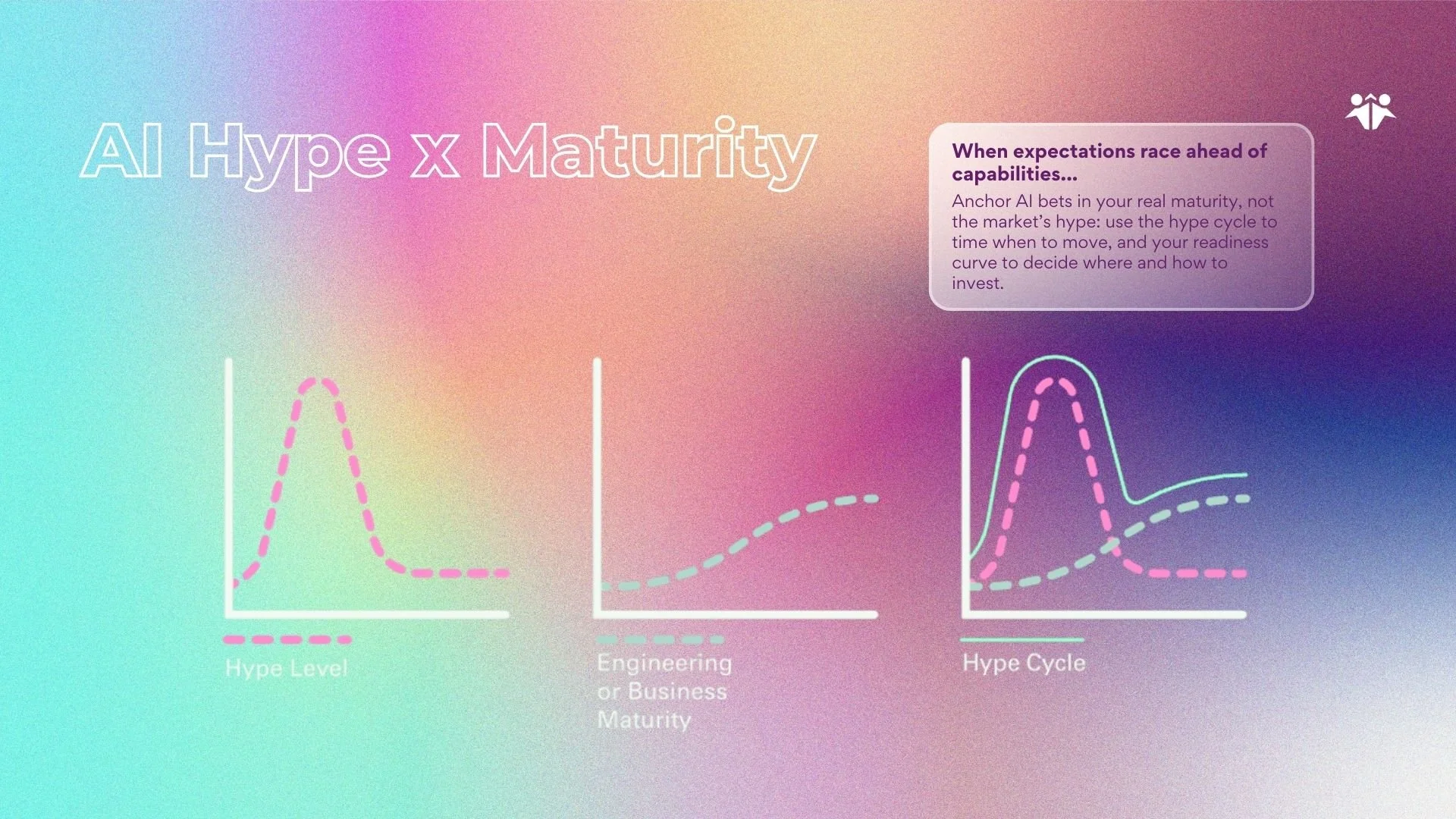
Oxford University, AI for Business Leaders
For leaders, the takeaway is simple: anchor AI decisions in your maturity, not the market’s excitement.
Use the hype cycle to understand where a technology sits in the wider ecosystem, but let your own readiness framework guide what you pilot, where you scale, and how fast you move. That is how you avoid the hype trap and build AI capabilities that actually support strategy, resilience and sustainability goals rather than distracting from them.
Turning Insight Into Action: Your Next 90 Days
You don’t need a three‑year transformation plan to start using AI well. You need 90 focused days that move you from abstract discussion to a concrete, sustainable AI roadmap.
Days 1–30: Align on Stance and Scope
In the first month, your goal is clarity.
Name your current posture. Use the four archetypes to have an honest conversation with your leadership and board: are you currently a pragmatic adopter, functional reinventor, business pioneer or internal transformer in sustainability?
Agree the scope of your readiness assessment. Decide whether you will assess the whole enterprise, a cluster of business units, or primarily the sustainability function and its closest partners (for example, finance, operations, procurement).
Confirm objectives and red lines. Capture in one page why you are exploring AI (e.g., disclosure quality, productivity, decarbonisation, supply‑chain insight) and what your guardrails are (e.g., no ungoverned use in target‑setting, strict rules for sensitive data).
By the end of Day 30, you want a shared understanding of why you are doing this, where you are looking, and how brave vs cautious you intend to be. That alignment will save you months of conflicting pilots later.
Days 31–60: Run a Pragmatic Readiness Assessment
n the second month, you move from stance to evidence.
Apply the core dimensions. Use the dimensions you defined above: strategy and governance, infrastructure, data ecosystem, models and interoperability, and talent, to score your current state against the five stages (Early Watchers to Embedded Leaders). Keep the scoring simple: workshops, interviews and a short survey are enough.
Ground it in real processes. Anchor the conversation in 3–5 critical sustainability workflows such as reporting, risk assessment, target‑tracking and supplier engagement. Ask: where does AI already show up, where could it help, and where would it be risky right now?
Map against the Sustainable AI Stack. For each emerging use case, consider lifecycle impacts: supply chain and materials, infrastructure, data, models, applications, in‑use governance and end‑of‑life. This helps you spot where “quick wins” might create hidden environmental or social costs.
Summarise the gaps. Distil your findings into a short readiness profile: your current stage by dimension, top three enablers, top three constraints, and any immediate “red flags” (for example, no clear governance but heavy experimentation).
By Day 60, you should have a concise, executive‑ready view of where you are on the maturity curve, where hype is pulling you off‑track, and which foundations must be fixed first.
Days 61–90: Design and Socialise your Sustainable AI Roadmap
The final month is about turning insight into a sequence of practical moves.
Choose 2–3 priority use cases. Based on your assessment, pick a small set of AI use cases that are high‑value for sustainability, technically feasible at your current maturity, and low‑regret from a risk and footprint perspective.
Define enabling moves. For each use case, list the enabling actions you need in the next 6–12 months: governance decisions, data improvements, vendor choices, skills and training, and any Sustainable AI Stack interventions (for example, more efficient infrastructure or tighter lifecycle management).
Set milestones and metrics. Translate your roadmap into a simple timeline with quarterly checkpoints: what will be piloted when, what “good” looks like, and how you will measure both impact (e.g., hours saved, quality of insight, emissions avoided) and integrity (e.g., compliance, model performance, energy use).
Engage your stakeholders. Share the draft roadmap with your sustainability committee, key executives and delivery partners. Use their feedback to refine the plan and to clarify decision‑rights, escalation triggers and resourcing.
By Day 90, you should have a living roadmap that links your AI stance, your readiness level, and your sustainability goals into one coherent plan.
How I Can Help
If you’d like support making this real, I work with sustainability leaders to:
Run a focused AI readiness and maturity assessment tailored to your function and sector
Design sustainable AI roadmaps that balance ambition, governance and environmental impact
If you’re ready to move from pilots to a grounded plan, you can:
Book a 30‑minute AI Readiness Consult, or
Get in touch via my Work With Me to explore a bespoke AI readiness and maturity engagement for your organization.