Sustainability Stakes: Navigating the 5 Pillars of AI Risk
Algorithmic Sustainability is the strategic practice of deploying AI systems that are carbon-efficient, ethically governed, and resilient to long-term model drift.
Introduction
In the frantic race to leverage AI for climate optimization and operational efficiency, many organizations overlook the hidden liabilities embedded in the technology. Implementing AI is a profound governance challenge that spans legal, security, and reputational boundaries. This article outlines the five foundational risks, from regulatory shifts like the EU AI Act to the carbon footprint of "un-Green" AI, that every organization needs to factor in to ensure their AI transformation is both ethical and resilient.
The 5 Key Risks Every AI Implementation Faces
When an AI system fails, it creates a butterfly effect. A single algorithmic glitch can paralyze a supply chain, freeze essential services, or trigger a cascade of digital failures. The impact is big. To counter it, we need effective AI governance. This begins with identifying where innovation meets liability.
This section breaks down the five foundational risks, from regulatory shifts and legal accountability to environmental impact, providing sustainability leaders with a clear roadmap to navigate the complex security and reputational challenges of modern deployment.
1.Operational Risks: System Reliability and Service Integrity
When AI systems fail in practice, the consequences often extend far beyond a temporary glitch. A single misstep can interrupt critical workflows, delay essential services, or trigger cascading failures across an organisation’s digital infrastructure. What begins as a technical fault can quickly evolve into a human or reputational crisis.
These risks highlight a central truth: operational dependability needs design foresight and accountability. AI must be built and monitored with the same discipline as any mission-critical system, which includes contingency planning, human oversight, and red-lining woven in from the start. Only then can organizations ensure continuity, safeguard users, and preserve trust when the unexpected occurs
2. Regulatory Risks: Navigating Global AI Compliance
In the rapidly shifting landscape of Global AI Compliance, "wait and see" is no longer a viable strategy. Organizations are now caught between horizontal data laws and vertical, sector-specific mandates. Before a model ever touches live data, legal frameworks, ranging from the GDPR and UK Data Protection Act to the California Consumer Privacy Act (CCPA), require a rigorous audit of data provenance and processing intent.
Add the financial stakes are rising. The financial stakes of a "compliance gap" have escalated from 4% of global annual turnover for GDPR, to tiered penalty structures coming after 7 - 11% of global revenue for non-compliance with the EU AI Act. With those numbers more almost tripling from 4%, the stakes have gone from rent to mortgage.
For Climate Tech firms and carbon-conscious enterprises, regulatory risk now includes a "Green" dimension. As governments move toward mandatory ESG reporting and Scope 3 emissions transparency, the high energy cost of non-optimized AI models could soon transition from a reputational headache to a liability. Proactive alignment involves Algorithmic Sustainability (model pruning, optimization, stress-testing) in a world where "dirty" or "opaque" data practices are increasingly viewed negatively
3.Legal Risks: Accountability and Liability in AI Decisions
The growing role of AI in decision-making blurs traditional lines of accountability. When automated systems influence hiring, lending, or healthcare outcomes, the organization behind them remains legally responsible for the consequences, whether those outcomes are fair, biased, or unlawful. Legal risk surfaces from the shadows not only when harm occurs, but when an organization cannot clearly explain or justify how an AI system reached its decision.
In practice, this means liability arises in unexpected ways: through algorithmic bias that reinforces inequality, opaque outputs that fail transparency requirements, or data practices that breach copyright law. Even well-performing models can create exposure if their inner logic disadvantages certain groups or violates emerging AI regulations. The legal landscape is shifting quickly, and without explicit governance and documentation, responsibility for AI-driven harm inevitably falls back on the deployer, not the code.
4. Reputational Risks: Maintaining Trust in Automated Systems
Reputation is one of the hardest assets to rebuild once trust is broken, and AI has a way of testing that trust at speed and scale. When automated systems produce biased outcomes, mishandle data, or make visible errors, the fallout can be immediate and amplified across digital networks, while at the same time giving the perception of poor oversight. And because public perception often moves faster than the investigation, this means that even a small oversight can spiral into a full-blown credibility crisis. By the time you’ve investigated a "biased" output, the digital world has already moved on, and taken its trust with it.
Reputational damage doesn’t always stem from malice or neglect; sometimes it arises from overcorrection or misunderstanding. A well-intentioned design choice can backfire if audiences see the result as misleading, unfair, or politically charged. In the age of algorithmic transparency, the standard for responsibility isn’t just technical accuracy, it’s alignment with social expectations of fairness and accountability. Once a system’s judgment is questioned, it can take years of consistent action and transparency to earn that trust back.
5. Security Risks: Protecting AI from Deception and Data Breaches
Security vulnerabilities in AI, are gateways for manipulation and misuse. Attackers can poison the well: by deceiving models into producing false outcomes, subtly corrupting the data that trains them, or extracting personal details from their outputs. Each of these weak points threatens the integrity and privacy of an AI system.
As these systems grow larger and more integrated, their attack surface expands too. This means that malicious actors can exploit gaps in oversight or design to weaken safeguards and compromise performance.
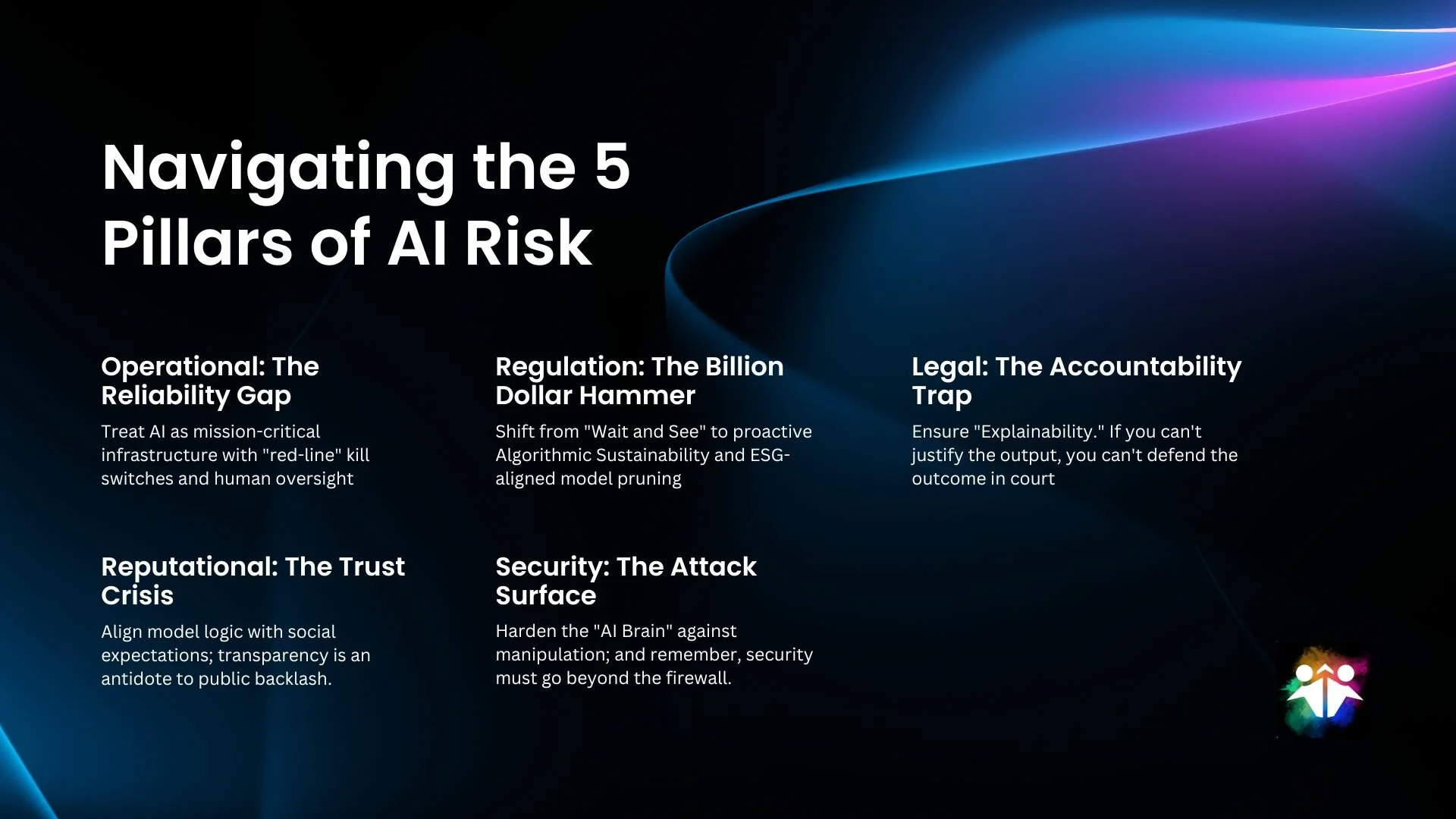
5 Pillars of AI Risk
Conclusion
Identifying these high-level risks is the first step toward Algorithmic Sustainability. However, awareness is not the same as mitigation. To truly protect an organization, leaders need to move beyond naming these threats and begin diagnosing the specific technical and human "failure modes" that allow these risks to manifest in real-world environments.
In my next article, I cover 9 human, technical and business factors that lead to AI failures.