Nature-Positive Data Centers: How the Tech Sector Can Build Sustainable AI Infrastructure - Water and Land Edit
Introduction
Last month I read the World Economic Forum’s Nature Positive: Role of the Technology Sector report, and it fundamentally reshaped how I think about AI infrastructure and sustainable data centers. The report highlights the UAE as one of 15 global data center hubs. With a population of 11 million and 32 data centers, its data center capacity is on par with the US. The country has positioned itself as a global digital and AI hub. Combined with its National Strategy for AI 2031, a new 5GW AI campus in Abu Dhabi as part of the US–UAE AI Acceleration Partnership, and its relationship with Microsoft to expand AI cloud and data centre infrastructure, this points to a coordinated, multi-billion-dollar programme focused on securing compute capacity and accelerating time-to-market for AI applications.
It is increasingly clear that data centers are no longer simply an enabler, but a determinant of future global power, and that power will ultimately depend on whether AI infrastructure can deliver nature-positive outcomes at scale.
Yet, on the flip side, data centers are among the most resource-intensive assets in the modern economy. As AI infrastructure scales, many data centers are being criticised for their sustainability impact. Beyond the visible demand for concrete, steel, copper, and aluminium, data centers can have significant hidden impacts on nature across water, energy, land, and waste. Addressing these pressures is central to the transition towards sustainable data centers and will determine whether future AI growth strengthens or undermines ecological resilience.
I believe there are 7 actions that tech sector needs to take to develop a nature-positive data centers:
1️⃣ Advance Resilient And Restorative Water Use
2️⃣ Mitigate Pollution and Pursue Circularity
3️⃣ Tackle Non-Power Operational and Embodied GHG Emissions
4️⃣ Promote Land Stewardship and Restoration
5️⃣ Power Operations Sustainably
6️⃣ Engage with their Supply Chain…covering Materials and Waste
7️⃣ Engage Externally and Support Policy Making
In this article, you will learn:
Practical strategies for sustainable water use in data centers
How land stewardship and biodiversity can be integrated into data center design
In the following two articles, I’ll review two more; Circularity and the Supply Chain, followed by Energy and Emissions.
The north star for water management in sustainable data centers is to embed water-use efficiency and resilience into AI infrastructure through proactive planning, onsite purification and reuse, and local replenishment, ensuring that operations contribute to nature-positive outcomes rather than cumulative water stress. And, when it comes to land management the tech sector whether data center providers, and those supplying the components should undertake initiatives to minimize ecological impact by directing development away from sensitive areas and integrating biodiversity into site planning and design
Advancing Resilient and Restorative Water Use in Data Centers
Effective water management begins with understanding local supply pressures. Assessing current and future water stress ensures data center developments minimise impacts on communities, ecosystems, and long-term operational resilience.
The World Economic Forum categorises the United Arab Emirates as a high cooling-need, water-stressed data center environment, requiring innovative solutions such as water recycling and advanced cooling technologies to remain viable.
1. Review sites for water stress
Assess current and future water stress at prospective site locations, and engage local and regional authorities to evaluate cumulative demand across the full water supply and ensure long-term availability. Prior to new developments, water stress can be assessed using public tools such as the World Resources Institute Water Risk Atlas, alongside engagement with government environmental bodies, to ensure projects do not place undue additional pressure on local water infrastructure
Example: When Google assessed a potential build in Arizona in 2023, they adjusted the design to use air cooling to reduce impact on the local water supply. The company developed their own Water Risk Framework to guide some of these decisions.
2. Design and Operate for Efficiency
Water efficiency should be embedded across the full lifecycle of data center development and operations. During the pre-construction phase, companies can design buildings and core processes to maximise water efficiency. Once operational, priority processes should be regularly reviewed and upgraded to address inefficiencies and reduce overall water consumption.
For energy-intensive processes such as cooling, companies can consider the trade-offs with water. For example, evaporative water cooling decreases power requirements, but results in increased water use. Conversely, avoiding evaporative water cooling can eliminate water consumption, but results in higher energy use. Depending on electricity source, this higher energy use can also result in increased water consumption along the value chain.
Using tailored assessments to determine the trade-offs between cooling designs, then working with local regulators and communities can support development of long-term, mutually supportive approaches.
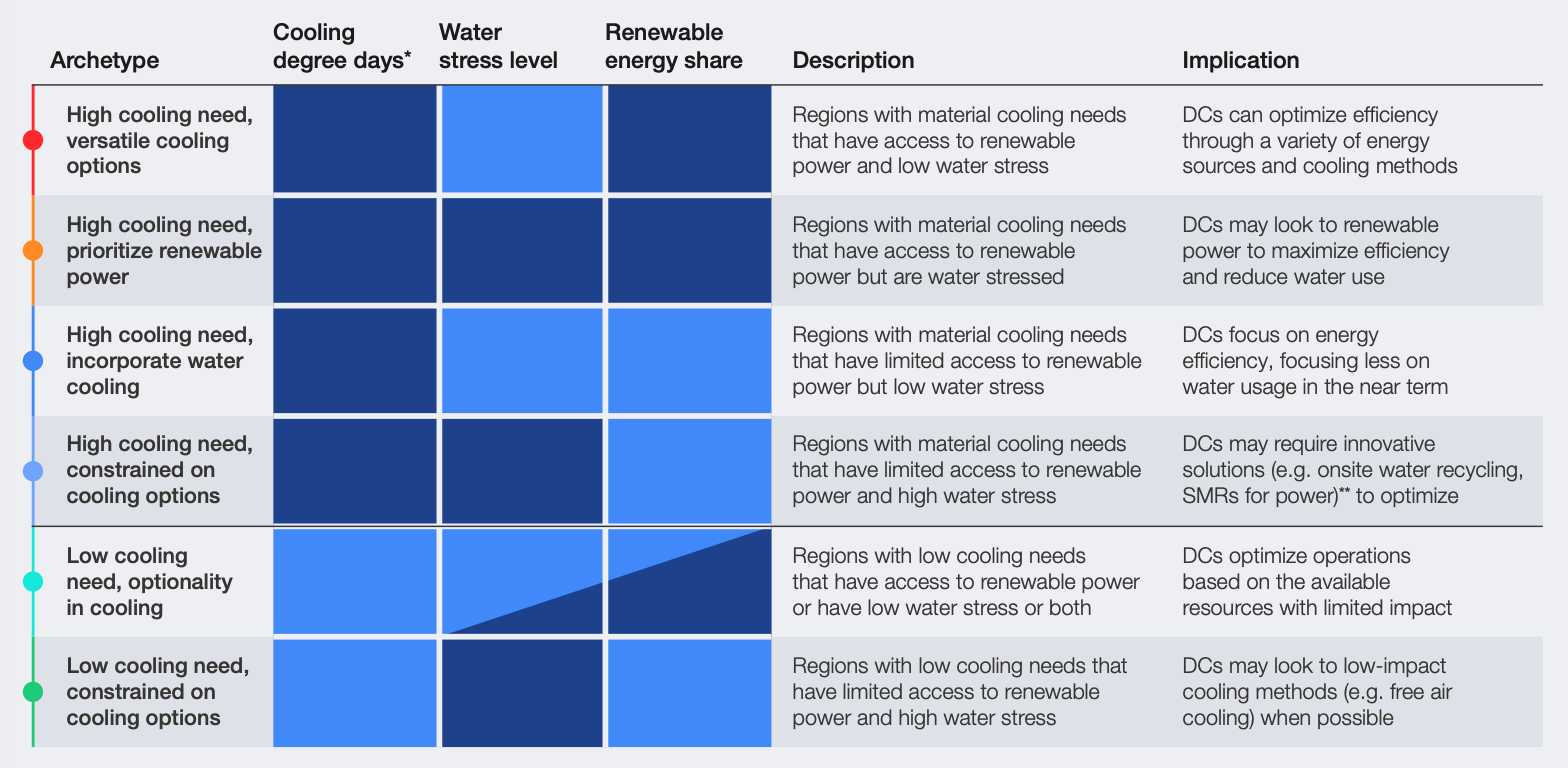
Power and Water Tradeoffs at Data Centers
3. Assess Complete Water Footprint
Companies should implement recognized standards, such as ISO 46001, to conduct a comprehensive accounting of water use across both operations and key supply chain components, including embedded water in energy generation. This full assessment helps identify priority areas for improvement. For direct operations, installing a monitoring system enables real-time detection of issues such as leaks or poorly optimised processes, allowing companies to address them quickly, whether through simple measures like component replacement or sealing leaks, or through broader process adjustments.
Example:
HCLTech has developed a system called AquaSphere to monitor facility water usage and provide insights on where and how water is used.
4. Closed Loop and Water Re-Use
Prioritize using non-potable water, where feasible, Or utilize closed-loop water systems for both server and facility cooling with onsite water purification to minimize net freshwater withdrawals.
Doing so enhances water recycling rates to cut overall consumption, addressing both operator costs and community concerns around water availability. This is especially important for semiconductor manufacturers due to requirements for ultra pure water and resulting high rates of water use. Some manufacturers already demonstrate high rates of water recycling.
Example:
Intel returns over 80% of its water for manufacturing reuse; while chip manufacturers in Taiwan reported an average wastewater recycling rate of 85% from 2016-2020. Microsoft and others are piloting closed-loop, chip-level cooling to avoid water evaporation.
5. Restore Local Watersheds
Companies should champion and support initiatives that monitor and restore local aquifers and watersheds, often collaborating with both local and global organizations to maximise impact and ensure long-term ecological resilience.
Example:
AWS takes a multi-pronged approach in its goal to be water positive by 2030. The company works with water charities to bring clean water to areas in need and partners with nature groups for restoration projects, such as restoring watersheds in Brazil and South Africa, and building wetlands to recharge and improve the quality of groundwater in the UK.
Promote Land Stewardship and Restoration
Land use is one of the most direct ways in which AI infrastructure interacts with nature. Promoting land stewardship and restoration is therefore essential to achieving nature-positive outcomes in data center development, particularly as facilities scale in size, energy demand, and physical footprint.
1. Prioritize Brownfield Development
Prioritize new developments in brownfield, or previously developed, areas to avoid net new impact. This action avoids direct impacts on intact natural ecosystems, and can mean lower land acquistion costs, as well as reduced costs associated with existing infrastructure, which can ultimately lead to faster time to market.
2. Assess Biodiversity Risk In Sites
Companies should use biodiversity risk assessments to guide site selection and avoid construction on high-value ecosystems, including critical habitats and protected areas. Site selection can be aided by way satellite data - I build on this in my article titled: How Earth Observation Technology for Climate Change.
When developing on brownfield sites or other locations, organizations can specifically avoid land classified as IUCN Categories Ia and Ib Protected Areas, World Heritage Sites, or other areas of critical ecological significance.
3. Establish Biodiversity Baseline
For new sites, conduct land assessments to identify any existing harm and establish a baseline to compare against when decommissioning a site to ensure any impact is remediated. This action acts as a strategic tool to reduce risks, streamline development and unlock financial value by reducing permitting delays and costs. Assessments ensure that companies track the impacts of their own operations on land and ecosystems over time, leading to data centers with greener credentials, which in turn can attract investment and high value tenants.
4. Green Roof
Companies should consider implementing green roofs and native landscaping to enhance local biodiversity, including pollinator-friendly habitats, while reducing or eliminating irrigation requirements. For both new and existing facilities, this can involve incorporating vegetation that naturally reduces heating and cooling needs, selecting native plants that provide wildlife habitat and require minimal maintenance, utilising rainwater harvesting and drought-tolerant landscaping where permitted, and applying natural pest control methods in place of chemical treatments. These measures not only support biodiversity but also improve resource efficiency and operational resilience.
Example:
Microsoft designed a data center in the Netherlands where it planted native trees and vegetation, converted turf areas into pollinator friendly habitats and introducing green space for employees, leading to stronger erosion control, improved soil quality, enhanced biodiversity and more natural aesthetics.
5. Biodiversity Offsets
Companies can use biodiversity offsetting to compensate for unavoidable habitat conversion and aim for no net biodiversity loss. This can include investment in high-quality offsets or landscape-scale restoration funds, such as the World Economic Forum’s Trillion Trees initiative. While offsets cannot perfectly replace local ecosystems, designing them to achieve No Net Loss (NNL) or, ideally, a Biodiversity Net Gain (BNG) improves outcomes. Results should be monitored and analysed to ensure effectiveness, with guidance available from frameworks such as those developed by the IUCN.
Example:
Several tech companies are supporting land and biodiversity conservation. NEC coordinates with the Teganuma Aquatic Life Study Group to promote conservation efforts, such as managing invasive species and conducting annual check-ins with biodiversity experts and city officials, for an endangered species of dragonfly that has a habitat located on premises.
Conclusion
In conclusion, the rapid expansion of AI infrastructure is reshaping global power dynamics, but it is also placing unprecedented pressure on natural systems. As the UAE’s coordinated push for compute leadership demonstrates, scale and speed are now strategic assets.
However, long-term advantage for the tech sector, globally, will depend on whether this growth is aligned with nature-positive outcomes. Sustainable data centers that are designed around water resilience, land stewardship, and ecosystem restoration, are now table stakes. They are core determinants of operational continuity, social licence, and regulatory trust, and will define whether AI’s future strengthens or depletes the natural systems on which it ultimately depends.
Related Reading
If you are interested in exploring how to manage the AI Energy Nexus, you may also find these useful: