Trustworthy and Sustainable AI: A NIST‑Aligned Guide for Sustainability Leaders
Building a Resilient Future: A Leader’s Guide to Trustworthy and Sustainable AI
For sustainability leaders, the push toward Green AI and Sustainable AI is about more than just reducing carbon footprints. It is about ensuring that the technology driving our global transition is as resilient as the ecosystems we aim to protect.
Trustworthiness in AI is a social and technical spectrum where the integrity of the whole is only as strong as its weakest link.
To navigate this complexity, I use the NIST AI Risk Management Framework (AI RMF) to translate the characteristics of trustworthy AI into practical choices for sustainability leaders who are already thinking in terms of ESG, climate resilience, and responsible innovation. This article also shows how these trustworthiness characteristics connect to broader Responsible AI and Green AI goals, so you can move beyond “check-the-box” compliance toward true digital stewardship.
What You Will Learn in This Article
The 7 NIST Characteristics of Trustworthy AI for Sustainability Leaders: A deep dive into NIST‑aligned pillars such as safety, security, bias management, and reliability in climate and ESG use cases.
Navigating the Trade‑offs in Trustworthy and Responsible AI: Why prioritizing one metric, like accuracy or efficiency, can sometimes compromise privacy, interpretability, or environmental impact.
An AI Lifecycle Risk Assessment for Sustainable and Green AI: A stage‑by‑stage framework, from development to sunsetting, to identify and manage risks before they become legal, environmental, or reputational liabilities.
The 7 NIST Characteristics of Trustworthy AI for Sustainability Leaders
According to the NIST AI Risk Management Framework, a system is only truly trustworthy when it balances a specific set of technical and social attributes. For sustainability-focused organizations, neglecting these characteristics increases the probability and magnitude of negative consequences that can undermine both your reputation and your ESG and sustainable AI objectives.
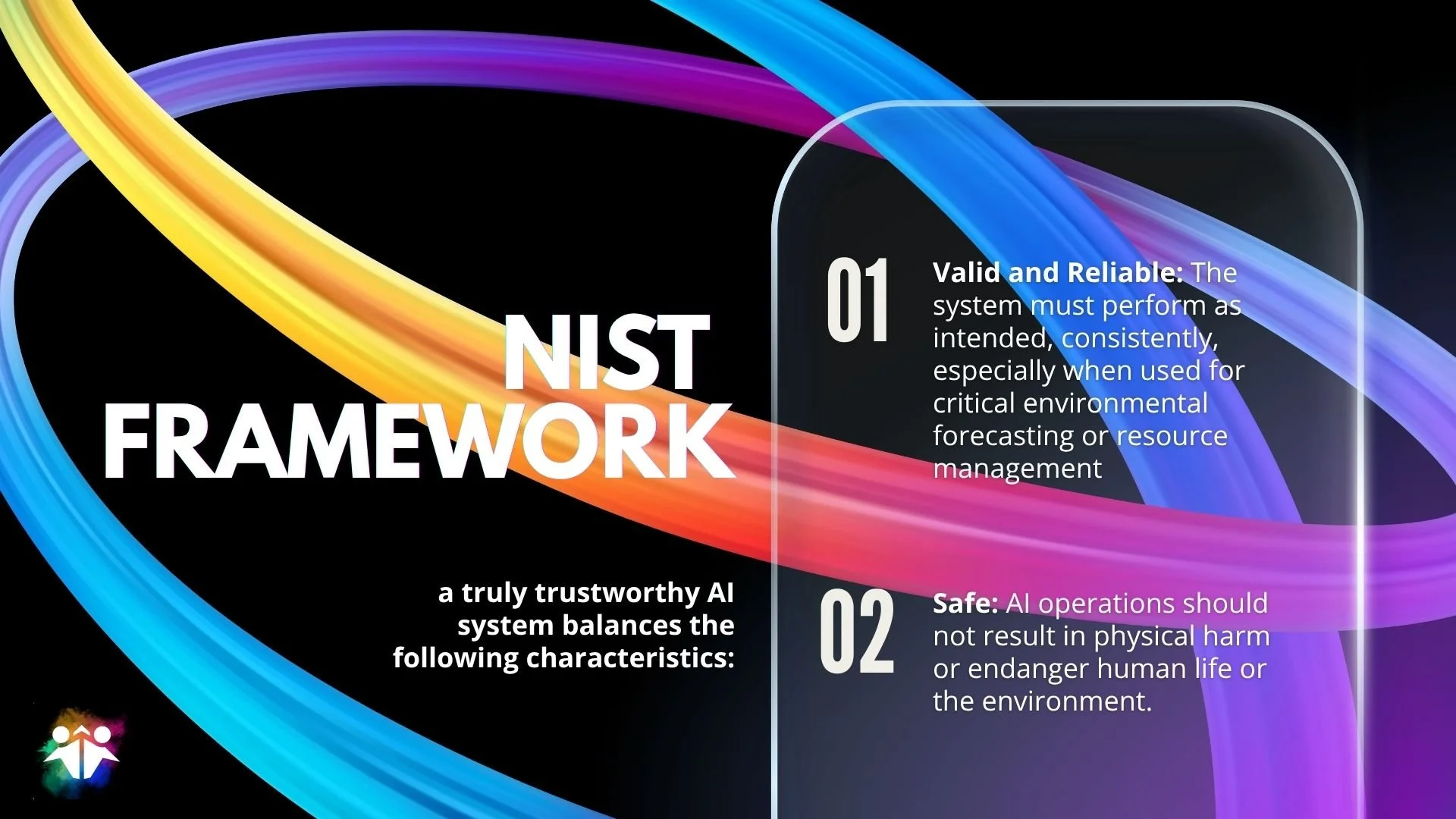
Trustworthy AI systems must be:
Valid and Reliable: The system must perform as intended, consistently, especially when used for critical environmental forecasting or resource management.
Safe: AI operations should not result in physical harm or endanger human life or the environment.
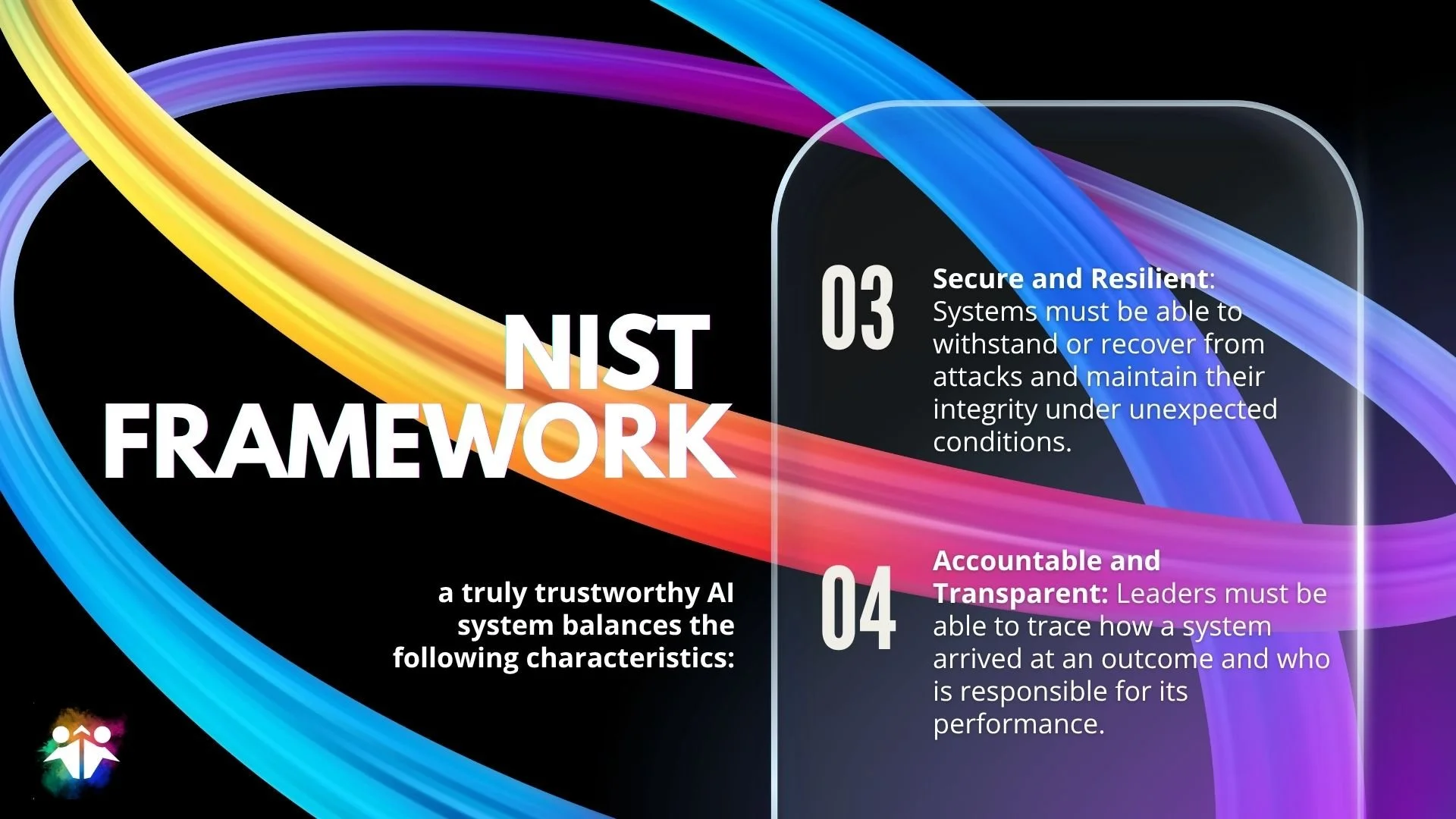
Secure and Resilient: Systems must be able to withstand or recover from attacks and maintain their integrity under unexpected conditions.
Accountable and Transparent: Leaders must be able to trace how a system arrived at an outcome and who is responsible for its performance.
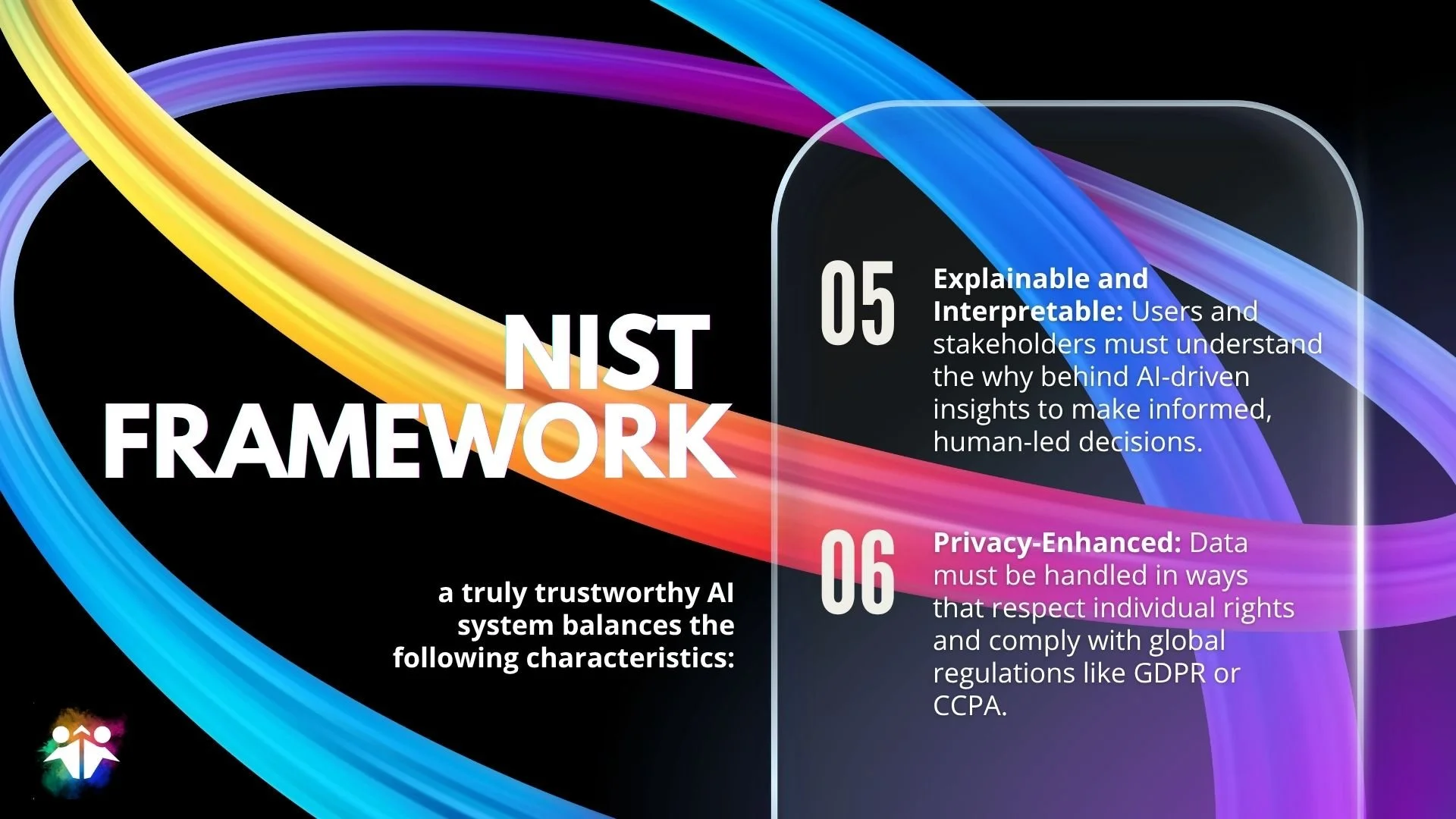
Explainable and Interpretable: Users and stakeholders must understand the why behind AI-driven insights to make informed, human-led decisions.
Privacy-Enhanced: Data must be handled in ways that respect individual rights and comply with global regulations like GDPR or CCPA.
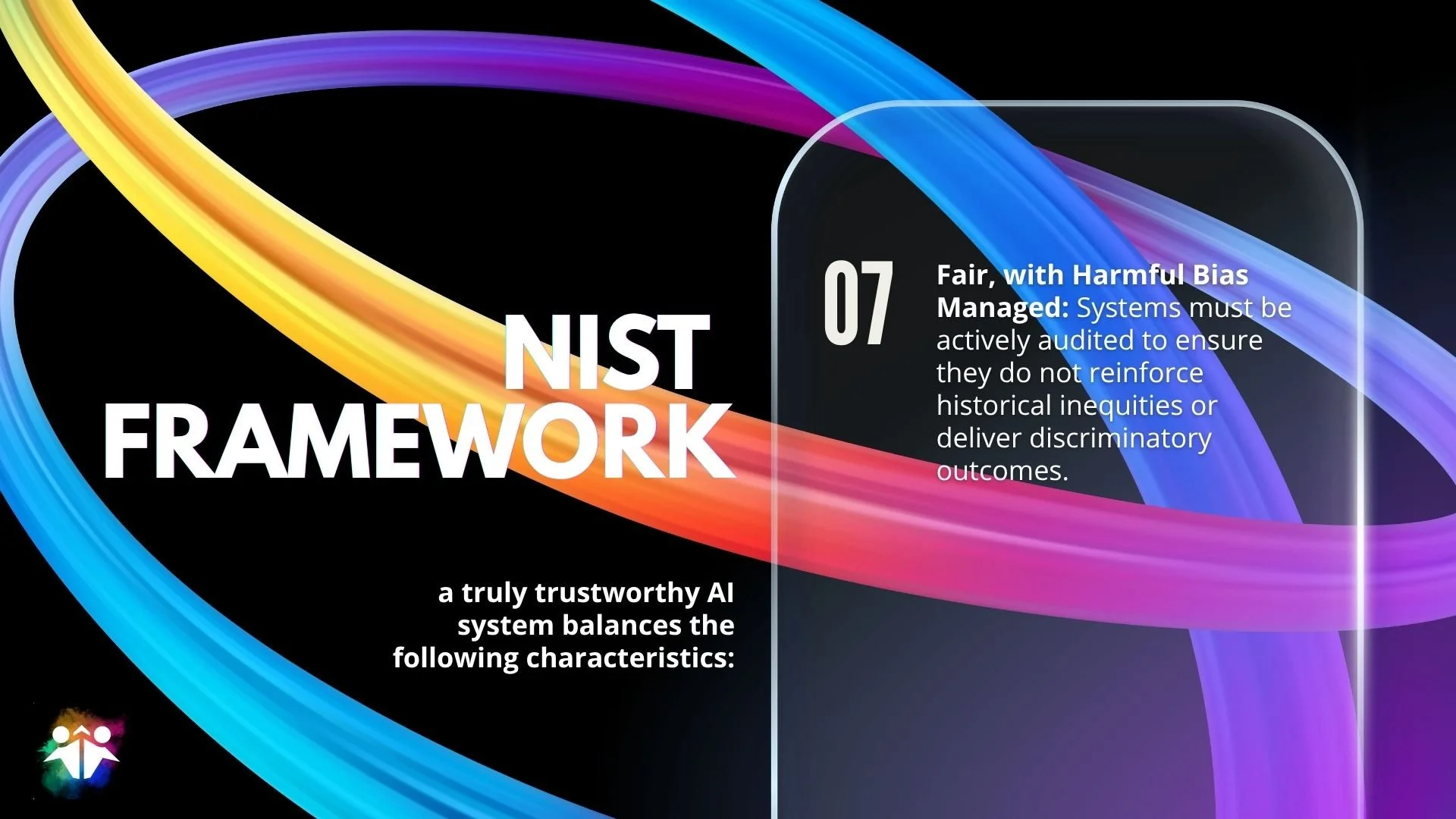
Fair, with Harmful Bias Managed: Systems must be actively audited to ensure they do not reinforce historical inequities or deliver discriminatory outcomes.
These NIST characteristics of trustworthy AI are related to, but distinct from, the broader characteristics of Responsible AI, which have evolved to incorporate more explicitly social and environmentally focused aspects. I unpack those Responsible AI dimensions in more detail in my article Responsible AI for Leaders: A Strategic Framework for Ethical and Scalable Development.
Balancing the Spectrum of Trustworthy Characteristics
It is vital to recognize that these characteristics are not isolated technical metrics; they are inextricably tied to social and organizational behavior. They depend on the datasets we select, the algorithms we build, and, most importantly, the human oversight that guides them.
And these characteristics specifically, ‘accountability’ and ‘transparency’ relate to the internal code of the system, are also deeply influenced by the external setting and context of use.
Developing trustworthy AI is an exercise in intentional balance. These core characteristics do not exist in isolation; they are deeply interconnected and frequently influence one another. Rarely will all characteristics apply in any given setting. And in each context some characteristics will be more important than other. All this leads to me to say, because of this interdependence, achieving "perfect" scores across every metric is rarely possible, nor is it always desirable. This approach to risk management will need leaders to move beyond a "check-the-box" mentality and instead actively determine which tradeoffs are acceptable to meet their specific mission and safety standards.
For example, a system that is highly secure but completely uninterpretable is a liability, as is a transparent system that lacks accuracy.
Despite the proliferation of ‘human-out-the-loop’ products that are flooding the market, sustainable AI leadership requires human judgment. It is up to us to decide the balance across the Trustworthiness characteristics, threshold values and metrics for success.
It is the joint responsibility of all AI stakeholders to determine whether AI technology is an appropriate or necessary tool for a given context or purpose, and how to use it responsibly.
Proactive Governance: AI Lifecycle Risk Assessment for Green and Sustainable AI
Because the pace of technological innovation often outstrips the speed of regulation, sustainability leaders cannot wait for legal mandates to define their guardrails. AI systems are already shaping critical decisions, social experiences, and environmental outcomes. Therefore, the decision to commission or deploy any AI tool must be rooted in a contextual risk assessment.
A robust assessment evaluates trustworthiness characteristics against relative risks, impacts, costs, and benefits, all informed by a diverse set of stakeholders. By anticipating the unique risks of AI systems early, organizations can surface concerns about fairness, bias, and transparency long before they evolve into legal liabilities or reputational crises.
To build systems that are as effective as they are ethical, leaders must embed rigorous inquiry into every stage of the AI lifecycle. The following framework outlines essential questions to incorporate into your risk assessment, covering everything from data integrity and legal compliance to human oversight and long-term environmental impact.
Stage 1: Development, Setting the Ethical Foundation
In the development phase, the choices you make regarding data and algorithmic design determine the long-term viability of your AI project. For leaders focused on sustainability, this stage is about ensuring "data integrity" goes hand-in-hand with "social responsibility."
1. Data Stewardship: Quality, Provenance, and Right to Use
Sustainable AI relies on high-quality, varied datasets that are sourced ethically. Before training begins, you must verify two critical factors:
Performance Fitness: Is the data accurate, representative, and robust enough to support the model’s intended environmental or social goals?
Legal & Ethical Provenance: Do you have the explicit right to use this information?
As data ecosystems expand, maintaining strict compliance with global privacy regulations, such as GDPR, the UK Data Protection Act, and CPRA, is not just a legal requirement but a cornerstone of digital trust. Prioritizing legal guardrails from day one prevents "technical debt" and future regulatory friction.
2. Inclusive Design: Testing for Bias and Under-representation
One of the most significant risks to sustainable AI is algorithmic bias. Hidden patterns in historical training data can inadvertently codify discrimination, leading to unfair outcomes that undermine social sustainability goals.
Beyond the Average: Your system must be stress-tested not only for average performance but specifically for "edge cases" and under-represented groups.
Equity as a Metric: It is a leadership responsibility to ensure models do not reinforce systemic discrimination based on gender, age, ethnicity, or socioeconomic status. A truly sustainable AI system is one that performs equitably for all stakeholders.
Global Context: Canada’s AIDA Canada’s proposed Artificial Intelligence and Data Act (AIDA) is one of the first to specifically target "high-impact systems." Leaders should note its heavy emphasis on human rights and economic bias. If your AI influences employment or credit, Canadian standards require proactive mitigation of "biased results" that go beyond the NIST suggestions.
Stage 2: Assessment, Validating Impact and Integrity
The assessment stage is where theoretical design meets real-world scrutiny. For sustainability leaders, this phase is about more than just technical benchmarking; it is an evaluation of how the system interacts with your most valuable assets, your data and your people.
1. Performance Continuity: Accuracy and Consistency
A sustainable AI system must be reliable over time, not just at launch. Even a perfectly designed model can "drift" as real-world conditions change.
Continuous Validation: Is the model delivering results that are both accurate and consistent with your original objectives? Regular audits are essential to ensure the system still meets your rigorous expectations for performance.
High-Risk Calibration: If your AI application manages sensitive environmental data or high-stakes social outcomes, the performance threshold must be significantly higher. There is no room for "approximate" accuracy when dealing with systemic risks.
2. Social Sustainability: Human Capital and Role Evolution
AI is a catalyst for organizational change, but that change must be managed responsibly. A leader's duty is to look beyond immediate efficiency gains and consider the broader impact on the workforce.
Skill Displacement vs. Evolution: Will the implementation of this system lead to a loss of critical human skills or roles? Before deployment, you must evaluate how the automation of specific tasks will affect your team, your organization, and your customers.
The "Efficiency Trap": Think beyond short-term productivity. Consider the long-term social consequences of your AI deployment to ensure you are augmenting human potential rather than merely automating it away.
Global Context: UAE’s Ethical AI Toolkit The UAE (specifically Dubai) has launched an Ethical AI Self-Assessment Tool. It is unique because it provides a "Legitimacy Score." For sustainability leaders, this framework is excellent for evaluating the social value of an AI project—asking not just if it works, but if the project should exist in the first place to benefit society.
Stage 3: Governance & Compliance, Establishing Accountability and Resilience
At this stage, your focus moves from the model’s performance to the organizational safeguards surrounding it. Effective governance ensures that AI remains a managed asset rather than an unpredictable liability.
1. Human-in-the-Loop: Defining Accountability and Intervention
While AI systems offer a degree of autonomy, they must never operate unchecked. A sustainable governance model requires a clear hierarchy of human oversight tailored to the specific risk profile of the use case.
Tiered Oversight: Does the situation require a "Human-in-the-loop" approach where every decision is reviewed, or is general supervision sufficient?
The "Ready to Act" Mandate: You must identify exactly who steps in when the system deviates from its intended path. Clear ownership is the difference between a minor technical glitch and a major systemic failure. What matters is that accountability is assigned, documented, and actionable.
2. Systemic Defense: Cybersecurity as a Strategic Pillar
In a sustainable enterprise, cybersecurity cannot be a post-script; it is an essential component of operational longevity. AI systems, (particularly those with high levels of autonomy), are high-value targets for misuse and sophisticated cyber-attacks.
Proactive Protection: Have you implemented measures to not only detect and prevent threats but also to respond and recover with minimal disruption through red-teaming?
Mitigating Misuse: Beyond external hacks, governance must account for internal misuse. Ensuring your AI is resilient against manipulation is critical to maintaining the integrity of your sustainability data and the trust of your stakeholders.
If you’re designing enterprise guardrails to keep AI risks proportional to impact, explore Why Sustainability Leaders Need AI Guardrails to Scale Impact Responsibly for a practical governance blueprint.
Stage 4: Operations, Maintaining Transparency and Trust
Once a system is live, the focus shifts to the user experience and long-term accountability. For sustainability leaders, the goal is to ensure that those impacted by its decisions have a clear voice.
1. Meaningful Disclosure: The Ethics of Transparency
Transparency is the bedrock of trust. If a user is interacting with an automated tool or an AI-driven process, they have a right to know, honestly and upfront.
Managing Expectations: Disclosure goes beyond a simple disclaimer. It involves clearly defining the system’s scope, what it is designed to do and, crucially, what its limitations are.
Building Digital Trust: By providing this clarity, you prevent "automation bias" (where users over-trust the system) and ensure that human stakeholders remain informed participants in the process.
Global Context: Singapore’s Model Framework Singapore is a world leader in "Practical AI." Their Model AI Governance Framework focuses heavily on Explainability. While NIST tells you what a system should be, Singapore provides the "Human-Centric" templates for how to explain AI decisions to customers. For leaders, this is the gold standard for building consumer trust during live operations.
2. Responsive Accountability: The Feedback and Appeals Loop
A sustainable organization must be prepared for the moment something goes wrong. A "set it and forget it" mentality is a significant reputational risk.
Formal Complaint Mechanisms: Is there a clear, accessible way for users to raise concerns or appeal an AI-driven outcome? A formal process for feedback and correction is not just helpful, it is an essential requirement for accountable leadership.
Proactive Resolution: Implementing a robust appeals process demonstrates that your organization takes its responsibilities seriously. It allows you to identify and mitigate systemic issues before they escalate into legal or ethical crises, ensuring the long-term health of your AI ecosystem.
Stage 5: The Sunset Stage, Responsible Decommissioning
The final phase of the AI lifecycle is often the most overlooked, yet it carries significant long-term risks. Proper "digital decommissioning" ensures that as a system reaches its end-of-life, it does not leave behind a legacy of hidden costs or security gaps.
1. Data Sovereignty and End-of-Life Management
When an AI system is retired, the data that fueled it remains. Leaders must have a clear strategy for how this information is handled to prevent it from becoming a liability.
Secure Deletion vs. Archiving: Does the data need to be permanently purged to meet privacy compliance (like the "right to be forgotten"), or should it be de-identified and archived for historical auditability?
Resource Recovery: Can the insights or high-quality datasets gathered during this lifecycle be repurposed for future, more efficient "Green AI" projects? Managing data as a reusable asset is central to a sustainable digital strategy.
2. Mitigating the "Zombie AI" Risk
Systems that are no longer actively maintained but remain connected to your infrastructure are primary targets for cyber-attacks.
The Clean Break: Ensure that all autonomous permissions, API keys, and access points are fully revoked upon sunsetting.
Final Accountability Audit: Conduct a closing assessment to document the system’s overall impact, lessons learned, and the final state of the data. This "post-mortem" provides the blueprint for making your next AI deployment even more resilient and sustainable.
Conclusion
For the sustainable leader, AI is the ultimate double-edged sword: a tool capable of solving our most complex environmental challenges, yet one that carries significant systemic risk. By adopting the NIST Framework for Trustworthy AI, you move beyond mere technical compliance and toward true digital stewardship. The goal is not just to build models that work, and to build ecosystems that endure. As we transition to a green economy, the integrity of our AI systems will define the resilience of our progress. Leading with trust today ensures a sustainable, equitable, and accountable legacy for tomorrow.
Related Reading
Why Sustainability Leaders Need AI Guardrails to Scale Impact Responsibly
Responsible AI for Leaders: A Strategic Framework for Ethical and Scalable Development - how to turn principles into an enterprise program