Why Sustainability Leaders Need AI Guardrails to Scale Impact Responsibly
Introduction
Artificial intelligence is a core business lever. Used effectively, it’s helping your organization to move faster, scale operations, and amplify human capability. But like any powerful lever, AI also magnifies consequences. As organizations deploy generative AI across hiring, customer engagement, analytics, and decision-making, the risks scale alongside the benefits. Errors propagate faster, bias becomes systemic, and reputational or regulatory exposure can expand dramatically.
So what do you do? For executives, the question is no longer whether to continue to use AI, but how to govern it responsibly. And, the answer lies in well-designed AI guardrails that balance innovation with accountability.
This challenge is especially acute as AI becomes embedded in climate strategy, sustainability reporting, and ESG decision-making, where errors can undermine regulatory compliance, stakeholder trust, and long-term value creation.
AI as a Force Multiplier, and a Risk Multiplier
As a force multiplier, you know that GenAI allows your people and and teams to do more with less, accelerating everything from content creation to data analysis. In competitive markets, this leverage is compelling and, in many cases, unavoidable.
However, AI is also a consequence multiplier. What do we mean by that? Well, when a human makes a mistake, the impact is usually limited. When an AI system makes a mistake, that error can be repeated thousands of times across customers, employees, or decisions before it is detected. For example, a biased hiring prompt, an inaccurate financial summary, or a misleading customer response can scale instantly and invisibly.
The same dynamic applies to sustainability use cases. An AI model used to prioritize environmental investments, assess supplier ESG risk, or support climate scenario analysis can rapidly scale flawed assumptions across sites, regions, or portfolios, magnifying impact before issues are detected.
This dual nature of AI needs attention, because scaling AI without governance amplifies operational, legal, and ethical risk.
AI Regulation Is Already Here, Yet the Liability Remains
One persistent misconception among organizations is that AI somehow dilutes responsibility. It does not. Regulators and courts are increasingly clear: AI is not a shield against liability.
AI regulations are already in force across multiple jurisdictions, either as standalone legislation or embedded within existing consumer protection, employment, and privacy laws. If your AI-driven hiring process discriminates, your organization is still accountable. If an AI-generated recommendation misleads investors, regulators, and stakeholders on climate performance, responsibility does not disappear behind the model.
For example, if an AI system used to estimate Scope 3 emissions materially misstates a company’s climate footprint, the organization remains accountable, regardless of whether the error originated in training data, model design, or automated assumptions. It’s also worth noting that the use of third-party models or automated tools does not transfer accountability. You, as leadership remain responsible for the integrity of AI-generated climate metrics and the decisions made on their basis.
For executives, this reality underscores the need to treat AI governance as an institutional capability, not a technical afterthought. Ethical principles, compliance standards, and accountability mechanisms must be defined at the organizational level so that every team operates within the same boundaries. For board‑level guidance on AI oversight, see our article on AI governance for boards.
The Foundation: Getting Your Data Ready
Beyond policies and ethical impact assessments, let talk about data. No AI system is better than the data it relies on. Outputs are only as good as the inputs and underlying datasets used to generate them. We’ve all heard it. Garbage in, garbage out; no matter how advanced the model.
This risk is particularly pronounced for sustainability data, which is often fragmented, estimated, and sourced across complex value chains. When AI is applied to climate or ESG data without sufficient validation, small inaccuracies can translate into material misstatements.
Before deploying generative AI for analysis or decision support, organizations need to validate their data rigorously. This includes checking for inaccuracies, inconsistencies, outdated information, and structural issues. And it’s worth noting that data preparation is not a one-time exercise; it requires continuous monitoring as datasets evolve and expand.
Ironically, generative AI itself can be a powerful tool in this process. Organizations can use AI to identify anomalies, flag missing or suspicious values, standardize formats, and surface inconsistencies across large datasets. For example, providing a representative data sample and asking an AI tool to identify potential quality issues can accelerate early-stage diagnostics.
That said, data preparation is most effective when multiple tools are used together. One tool might convert or normalize data formats, while another is used to interrogate the cleaned dataset. For executives, the key takeaway is simple: investing in data readiness is not optional. It is the prerequisite for trustworthy AI.
And then there are five types of guardrails you can adopt to make your AI roll-out more trustworthy.
What Are AI Guardrails?
AI guardrails are the filters, rules, processes, and controls placed around AI systems to ensure outputs align with organizational values, legal obligations, and business objectives.
They operate at multiple points in the AI lifecycle: before prompts are submitted, while models generate responses, and before outputs are delivered or acted upon. Without guardrails, even well-intentioned AI deployments can produce inappropriate, biased, misleading, or unusable results.
From an executive perspective, implementing guardrails are about making AI safe, reliable, and scalable, without limiting innovation.
In sustainability contexts, guardrails play an additional role: they help ensure that AI-supported climate and ESG outputs are credible, defensible, and aligned with regulatory and stakeholder expectations.
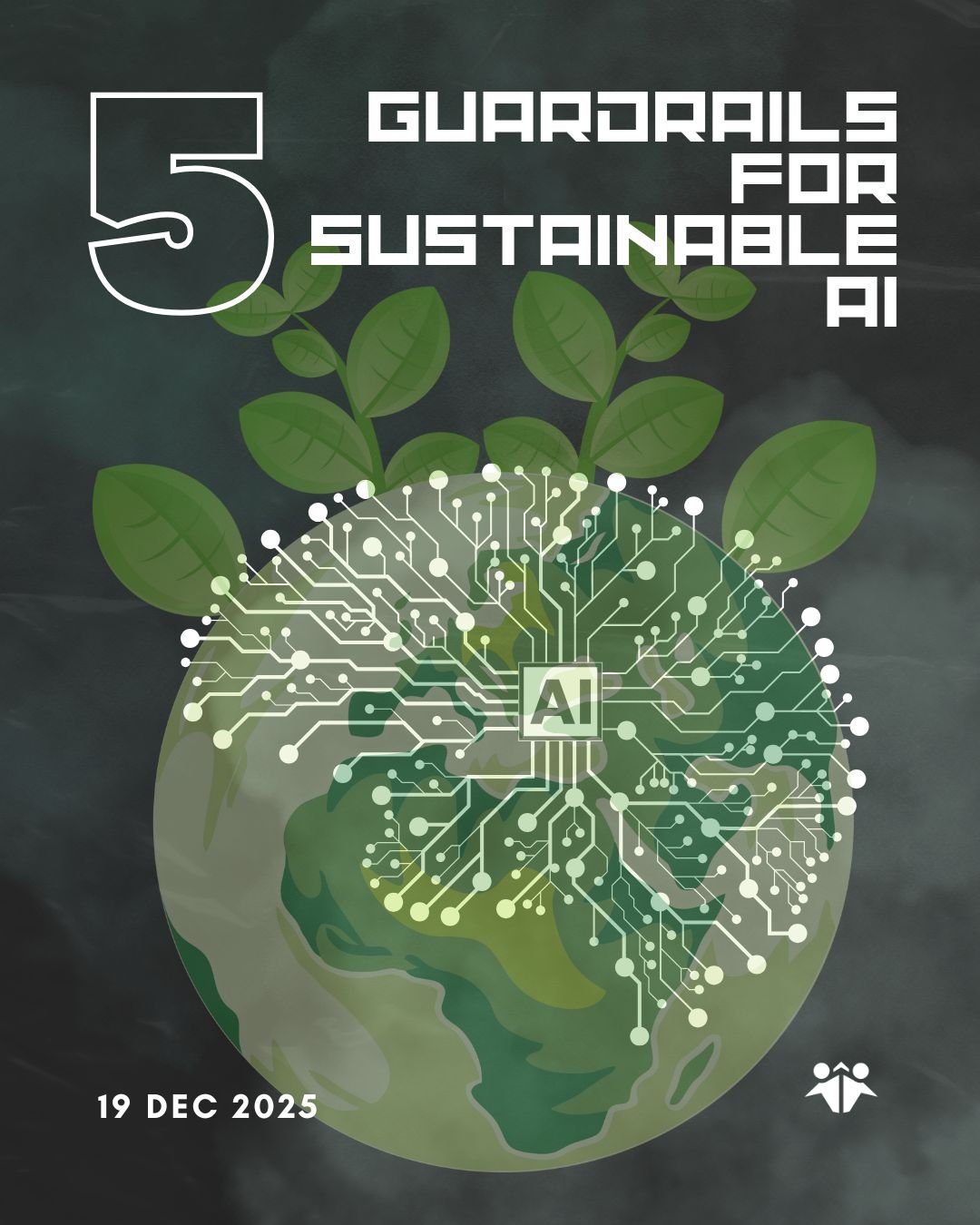
Below are a few examples of guardrails that you can deploy:
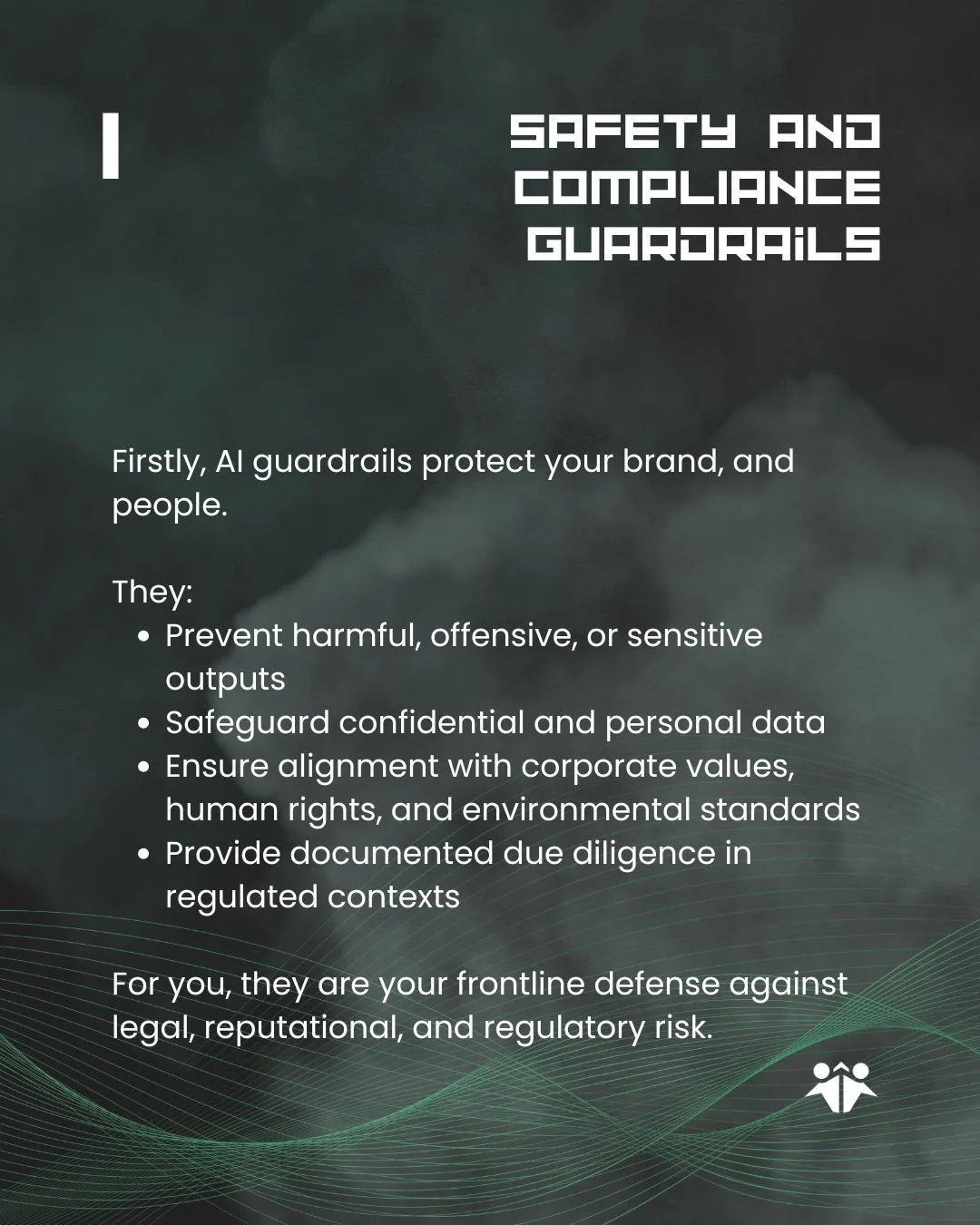
1️⃣ Safety and Compliance Guardrails
Safety and compliance guardrails are designed to reduce regulatory and reputational risk. They filter offensive or inappropriate content, detect harmful or sensitive prompts, and prevent the misuse of confidential or personal data.
This includes risks related not only to traditional AI regulation, but also to environmental compliance, human rights due diligence, and the responsible treatment of communities and ecosystems affected by business decisions.
These guardrails ensure that AI outputs align with corporate values and professional standards, particularly in customer-facing or high-stakes contexts. They also help organizations demonstrate due diligence in regulated environments by documenting how risks are identified and mitigated.
For leadership teams, safety guardrails are a clear line of defense against brand damage and legal exposure.
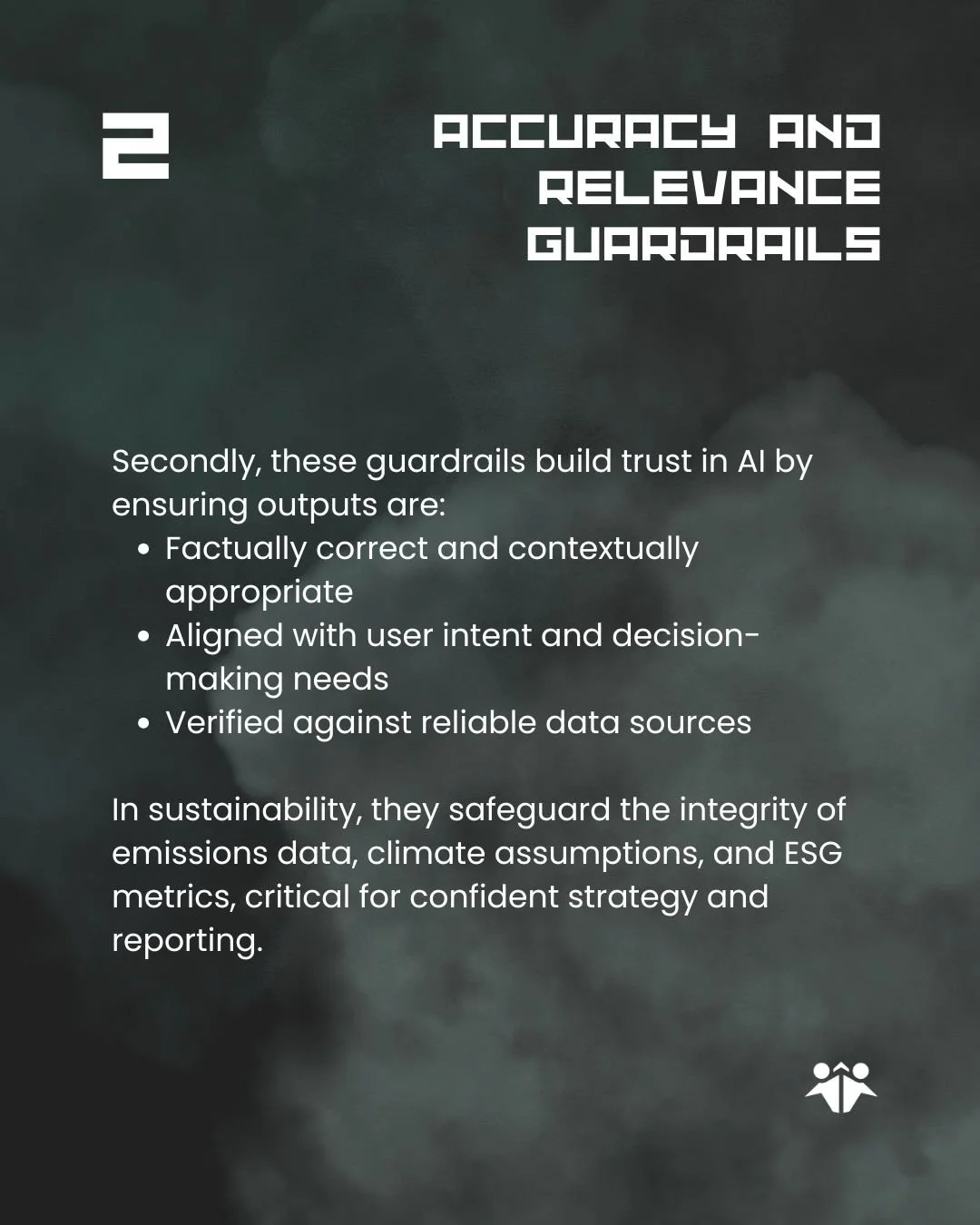
2️⃣ Accuracy and Relevance Guardrails
Accuracy and relevance guardrails focus on trust. They are designed to ensure that AI responses are factually correct, contextually appropriate, and aligned with user intent.
These controls may include validating claims against trusted data sources, checking whether referenced URLs or facts are current, or ensuring responses stay within defined scopes. In decision-support scenarios, these guardrails are essential for preventing subtle but costly errors.
In sustainability use cases, these guardrails are essential for ensuring the reliability of emissions calculations, climate assumptions, and ESG performance indicators that inform disclosures and strategic decisions.
Accuracy and Relevance guardrails act as controls for foundational confidence in AI-driven insights and recommendations.
3️⃣ Quality and Readability Guardrails
Even accurate information can fail if it is poorly communicated. Quality and readability guardrails assess clarity, tone, and structure, ensuring the outputs from your models meet professional communication standards.
These guardrails help remove redundancy, improve coherence, and maintain consistent language across teams, regions, and audiences - that’s why so much AI content sounds the same, it’s removing redundancies that make us human.
But, for organizations operating globally or at scale, this coherence and consistence is critical. From an executive standpoint, these controls protect not just accuracy, but perception. These guardrails help ensure your AI-generated content reflects your organization’s professionalism.
4️⃣ Integrity and Brand Alignment Guardrails
Integrity and brand alignment guardrails ensure that AI outputs reinforce, rather than undermine, strategic objectives. They validate factual context, prevent inappropriate competitor references, and check claims, such as pricing or performance, against authoritative internal data.
This is particularly important for sustainability narratives. AI-generated climate or ESG claims must align with verified internal data and stated strategy, or they risk undermining credibility and exposing the organization to greenwashing allegations.
These guardrails help ensure your AI-generated content supports brand positioning and business goals, rather than introducing confusion or risk. For your leadership team, this is where AI governance directly intersects with corporate strategy.
And, finally….
5️⃣ The Critical Role of Human-in-the-Loop
No AI system possesses human judgment, contextual awareness, or lived experience. This is why human-in-the-loop oversight is essential. It’s especially true for climate and sustainability decisions, which involve long-term impacts, uncertainty, and value-based trade-offs that no model can fully resolve without human judgment.
A human-in-the-loop approach combines machine efficiency with human judgment at key points: training, deployment, review, and refinement. If you have strong employees, they’ll validate the outputs, challenge the assumptions, and intervene when AI responses are uncertain or inappropriate.
This approach is particularly important given AI’s inherent limitations, such as knowledge cutoffs, where models are trained on data up to a specific point in time, and may lack awareness of recent developments. We all know that when AI attempts to compensate for this gap, it can produce hallucinations - confident but false outputs.
While hallucinations can be useful in creative contexts, they are dangerous in analytical, legal, or customer-facing scenarios. Human review is the most effective way to mitigate this risk.
Conclusion
For executives, responsible AI is a leadership mandate. As it scales across the enterprise, so do its risks and consequences. Guardrails provide the structure needed to innovate with confidence, protect your organization, and earn trust from customers, regulators, and employees alike.
In an era where AI increasingly shapes climate strategy and sustainability performance, trustworthy AI is a prerequisite for credible commitments and durable enterprise resilience. By combining strong data foundations, layered guardrails, and human oversight, leaders can harness AI’s power without surrendering accountability, and turn responsible AI into a lasting competitive advantage.