How Sentiment and Social Media Inform the Twin Transformation of AI and Sustainability
Twin Transformation success depends not just on AI and sustainability implementation, but on stakeholder trust. Monitoring social sentiment provides early signals that help leaders manage risk, validate communication, and strengthen legitimacy.
Introduction
I’ve written a lot about the intersection of AI and Sustainability. A pretty niche topic I thought. But, last year Roland Berger introduced the concept of the Twin Transformation; the simultaneous pursuit of artificial intelligence (AI) and organizational sustainability goals.
According to Roland Berger, this dual transformation offers companies not only operational efficiency, environmental impact reduction, and strategic competitive advantage, at its core, the Twin Transformation challenges organizations to rethink how technology and purpose co-evolve.
Yet, despite the technical focus of many initiatives, perception and sentiment increasingly determine transformation success. We all know that change is as much a people issue as it is anything else. Today’s leaders must recognise that stakeholder trust, and the narratives that shape it, are as consequential as internal strategy or implementation plans. This article explores why sentiment, perception, and social media monitoring are essential strategic tools in guiding your Twin Transformation.
Defining the Twin Transformation
Twin Transformation refers to the intersectional integration of AI-driven innovation and sustainability imperatives, pursued not as siloed objectives but as mutually reinforcing strategies.
I believe that organizations that synchronise AI and sustainability can unlock synergies that accelerate resource optimisation, innovation cycles, and competitive differentiation.
For communicators and strategic leaders, this raises a fundamental question: how do our stakeholders perceive the value and risks of this dual transformation? The answer may lie in digital sentiment, scraped from social media platforms.
Perception and Sentiment: Signals to Inform, Not Dictate Strategy
The report highlights that discussions about AI and sustainability carry nuanced sentiment patterns across both traditional and social media channels. Notably, social media sentiment, from 2024, tends to be more positive about the integration of AI and sustainability compared to traditional media coverage.
I believe this delta reflects differences in audience, volume, framing, and immediacy. Whilst social media amplifies innovation stories and community enthusiasm, traditional outlets focus on risks, regulation, and crucially, take a critical view.
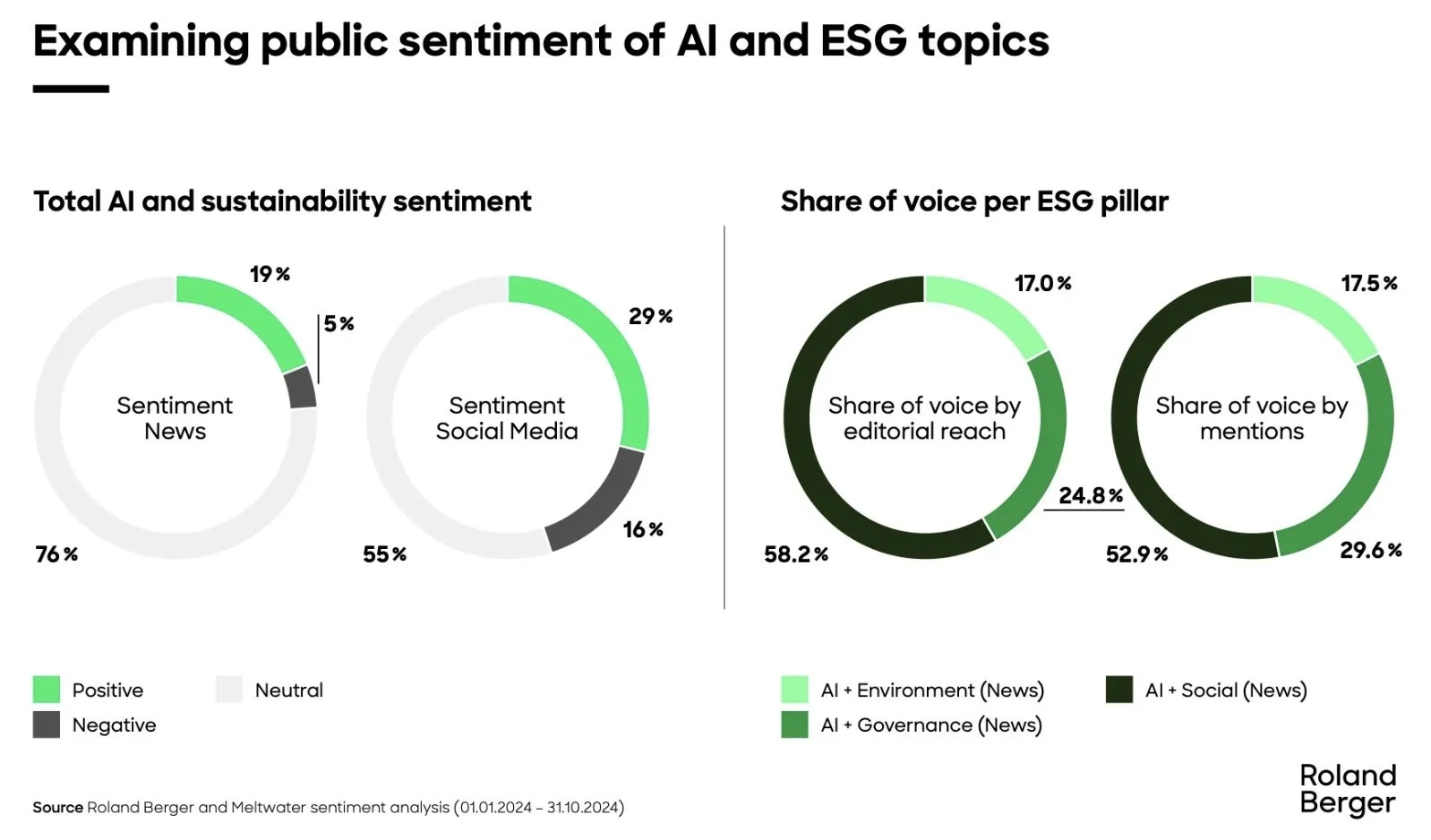
Roland Berger, AI and Sustainability: How Twin Transformations can Succeed (2025)
For example, social media conversations often emphasize the innovation potential and societal benefits of these technologies, such as advancements in climate tech and healthcare, whilst they do at the same time, reveal ongoing concerns around energy consumption and the ethical governance of AI applications. This duality illustrates that public dialogue does encompass both optimism and caution, but perhaps not at the level that traditional news media can delve into.
Importantly, it’s worth noting that social media discussions also surface emerging risk narratives that can shape perceptions among regulators, investors, and employees, and so can have a stronger impact on a company, affecting ESG scores through to employee turnover rates.
For senior leaders, this suggests that sentiment should be viewed not merely as a record of “what people think,” but as a leading, yet shallow, indicator of stakeholder response ⇒ a signal that can guide strategy, communication, and decision-making in real time.
Social Opinion as Insight: Recognizing Its Impact on Trust and Legitimacy
Social media acts as a momentary pulse, and when that data is fed into wider firm reputational data it can form part of a dynamic stakeholder feedback loop. Organizations that integrate sentiment analytics into their Twin Transformation strategies can:
Anticipate reputational risk by detecting negative narratives early
Validate communications strategies against real-world sentiment trends
Tailor messaging for specific audiences across regions and platforms
Inform risk frameworks and governance structures with public sentiment insights
This aligns with broader industry research on responsible technology adoption. For example, McKinsey’s Global AI Trust Maturity Survey states that organizations benefit when they invest in practices that foster trust through data governance, explainability, accountability, which then directly shape stakeholder confidence in AI adoption. (McKinsey & Company) My article on the 6 principles of Responsible AI adoption capture this as well - link here.
Similarly, Bain’s research shows that while executives may be shifting attention toward AI and inflation, consumers and B2B buyers continue to prioritise sustainability in purchasing decisions, reinforcing the need for credible narrative and trust-building. (Bain)
Strategic Narrative: Trust as Competitive Advantage
Sentiment and perception analysis are vital because they indicate trust, and trust is a competitive asset in the Twin Transformation:
Trust accelerates adoption: When stakeholders perceive AI and sustainability initiatives as credible, adoption barriers fall.
Trust reduces risk: Misunderstandings or mistrust can compound regulatory and reputational risk.
Trust attracts talent and investment: Organizations perceived as trustworthy attract talent and capital aligned with long-term sustainable value creation. (🙌🏽 I’ve personally walked away from offers when their leadership lacked credibility!)
The World Economic Forum (WEF) has echoed the importance of trust in AI efforts, emphasising that without stakeholder trust, the potential of AI to transform business practices—and by extension, sustainability outcomes—will be constrained. Leaders must therefore prioritise trust-building across organizational and external engagement strategies (World Economic Forum).
How To Operationalize Sentiment Intelligence, and do it Sustainably
For sustainability focused on strategic impact, sentiment analysis should be integrated into transformation frameworks across:
Governance: Use sentiment insights to inform governance policies that address stakeholder perceptions of AI ethics, sustainability commitments, and transparency.
Communications Strategy: Align internal and external communications with patterns from sentiment analysis to avoid misalignment between intent and perception.
Risk Management: Map sentiment trends to risk frameworks to anticipate regulatory, social or investor pressure.
Change Management: Leverage sentiment data to tailor how transformation is communicated to employees, partners, and customers to reduce resistance and boost adoption.
How to integrate ESG Sentiment Analysis into Your Organization
And of, course it would be remiss of me to not include here, that whilst AI-driven sentiment analysis offers unparalleled insights into sustainability trends, it presents a paradoxical challenge. A conventional AI approach for social media analysis depends on high-compute deep learning models that process data indiscriminately. These systems are energy-intensive, opaque and computationally inefficient.
So, how do companies get past this? For me it’s down to designing models with efficiency in mind, and selectively deploying for impact. This can include:
Hybrid AI architecture that integrates rule-based reasoning, supervised ML and natural language processing guided by a bespoke emotion ontology
A semantic filtering layer that ensures only emotionally relevant content is processed, enabling deployment on ultra-low-power hardware
This has 3 main advantages:
1. Massive Reduction in "Carbon Debt"
Traditional sentiment analysis often relies on Large Language Models (LLMs) that require millions of dollars in electricity and water to train. By integrating rule-based reasoning and a bespoke ontology, you rely on structured human knowledge rather than raw brute-force computation. This drastically reduces the initial energy and water required for training because the model "understands" the domain rules from day one, rather than having to "guess" them by processing trillions of words.
2. Elimination of "Processing Waste" through Semantic Filtering
In social media scraping, up to 90% of collected data is often "noise" (spam, ads, or irrelevant chatter). Standard AI models often process every single byte of this data before discarding it, but using a semantic filtering layer acts as an "environmental gatekeeper." It discards irrelevant data before it reaches the power-hungry machine learning components. This means you aren't burning electricity to analyze a tweet about a "green apple" when you are actually looking for "green energy" sentiment.
3. Ultra-Low-Power (Edge) Deployment
The most significant environmental cost of AI today is the "inference" phase; the energy used every time the model answers a query. Large models require massive, water-cooled data centers, but if you design your architecture to a specific ontology (a "map" of emotions) and filter for relevance, the "math" the computer has to do is much lighter. This allows the system to run on ultra-low-power hardware (like mobile chips or specialized AI sensors) that can be cooled by air rather than millions of gallons of water.
It’s about designing AI models that are smart enough to analyse sentiment world without using up huge amount of resources to do it.
Practical Steps for Leaders
Integrate social listening into transformation KPIs. Sentiment should be tied to measurable business outcomes and transformation milestones.
Foster cross-functional collaboration. Communications, sustainability, and transformation teams should jointly interpret sentiment analytics.
Invest in narrative credibility. Prioritise transparency and evidence-based messaging to counter misinformation and build trust.
Benchmark against industry insights. Use reports from trusted sources like McKinsey, Bain, and WEF to contextualise organizational sentiment within broader trends.
Conclusion: Sentiment as Strategic Currency
The Twin Transformation, when communicated effectively, can generate operational value and stakeholder trust that underpins long-term resilience. In an era where digital and public narratives shape stakeholder expectations with unprecedented speed and reach, sentiment analysis should be factored into strategy formation.
Senior leaders in communications, sustainability, and corporate strategy should therefore treat sentiment not as noise, but as a core input into transformation design and execution. Those who do are better equipped to steer organizational purpose, credibility, and competitive advantage in an increasingly complex landscape.