Why AI Agents Are the Next Strategic Advantage for Sustainability Leaders
Introduction
AI agents are a big part of your next operating model rethink. Your sustainability teams are increasingly operating in a complex environment: expanding disclosure requirements, fragmented data landscapes, rising stakeholder scrutiny, and limited internal capacity.
And, while many organisations have adopted analytics tools and dashboards, these approaches often remain reactive and labour-intensive.
AI agents represent a material shift in how sustainability work gets done. Rather than simply analysing data or generating outputs on demand, AI agents can autonomously execute tasks, monitor performance, and surface insights, acting as digital team members embedded within your sustainability operations.
This results in a fundamentally different operating model.
The Core Challenges Sustainability Executives Face Today
Despite increased investment in sustainability platforms, several systemic challenges persist:
-
Emissions, energy, supplier, and operational data are often dispersed across multiple systems, geographies, and business units. Sustainability teams spend disproportionate time validating, reconciling, and explaining numbers rather than acting on them.
-
Frameworks such as CSRD, CDP, GRI, and ISSB continue to evolve. Manual reporting processes increase compliance risk, consume scarce expertise, and limit an organisation’s ability to respond quickly to regulatory change.
-
Boards, investors, regulators, customers, and internal teams increasingly expect timely, decision-grade sustainability insights, not static reports produced months after the fact.
AI agents are particularly well-suited to address these challenges because they operate continuously, across systems, and at a scale that human teams cannot.
What Makes AI Agents Different from Traditional AI Tools
To understand their value, it is important to distinguish AI agents from more familiar AI capabilities.
Traditional analytics and generative AI tools are largely reactive: they respond to prompts, generate reports, or visualise data when asked. AI agents, by contrast, are goal-oriented and autonomous
Key characteristics include:
Autonomy: Agents can monitor data streams, trigger actions, and complete tasks without constant human input.
Decision-making: Agents apply rules, models, and contextual understanding to decide what action to take.
Execution: Agents can move beyond insight to action—updating systems, generating disclosures, or initiating workflows.
From a leadership perspective, this distinction matters because AI agents do not just accelerate existing processes; they reduce dependency on manual intervention altogether.
High-Impact Sustainability Use Cases for AI Agents
When deployed thoughtfully, AI agents can deliver tangible value across the sustainability lifecycle.
1. Continuous Sustainability Intelligence
AI agents can continuously analyse emissions, energy, and operational data, surfacing anomalies, trends, and risks in near real time. It can also be used to scrape social media for reference to the company’s sustainability commitments. Executives gain earlier visibility into performance gaps, and a pulse on sustainability sentiment rather than waiting for quarterly or annual reviews.
2. Automated Reporting and Disclosure
Agents can map data to regulatory frameworks, generate draft disclosures, maintain audit trails, and flag inconsistencies. This reduces reporting effort while improving confidence in regulatory submissions.
And, here is 4 Ways that Google’s Sustainability Team Themselves are Using AI for Reporting. However, human oversight, explainability and judgment remain fundamental to managing risks associated with disclosure.
3. Supplier Data Collection and Quality Improvement
Supplier engagement remains one of the most resource-intensive aspects of Scope 3 management - all whilst your team are getting some sleep. AI agents can automate outreach, cross-reference incoming data, follow up on gaps, and highlight suppliers that pose material risk.
4. Stakeholder Q&A and Decision Support
Executives and boards increasingly expect rapid answers to sustainability questions. AI agents can respond to natural-language queries with traceable, up-to-date insights drawn from trusted datasets.
5. Decarbonisation Planning and Operational Optimisation
By analysing historical performance and operational constraints, AI agents can support scenario analysis, prioritise interventions, and recommend actions that balance sustainability goals with business performance.
Leadership Considerations: Governance, Risk, and Readiness
While the potential is significant, successful adoption requires executive oversight in several areas. It needs a human-in-the-loop.
Data Governance and Quality
AI agents amplify both strengths and weaknesses in underlying data. Clear ownership, validation processes, and governance frameworks are essential to ensure outputs are reliable and defensible. I’ll say it again, as a company you remain liable for for incursions created by your agents, and so governance is key.
Responsible and Ethical AI
Executives must ensure AI agents operate transparently, align with company values, and comply with emerging AI regulations. Human oversight remains critical for high-impact decisions. (Yep, same as above, humans are needed for governance). For more information, on the six principles that underpin Responsible AI, you can find my article, here.
Integration with Core Business Systems
AI agents deliver the most value when embedded within existing enterprise platforms rather than operating as standalone tools. Integration enables agents to act, not just analyse.
A Practical Roadmap to Operationalising AI Agents
I’ve spoken many times about scaling AI operations, and operationalising AI agents are not that different, so I won’t go into too much detail here. But, for sustainability leaders it’s important to note that a phased approach reduces risk while accelerating value.
-
Focus on areas where manual effort is high, risk is material, and data already exists, such as reporting, data collection and reconciliation, or supplier engagement.
-
Evaluate data completeness, consistency, and accessibility. Address foundational gaps before scaling autonomy.
-
Deploy agents that support teams rather than fully autonomous systems. This builds trust and organisational confidence.
-
Define escalation paths, auditability requirements, and performance metrics for AI agents.
-
As confidence grows, expand agent responsibilities to include continuous monitoring, proactive alerts, and automated execution, However, retain human oversight. Agents are here to help us orchestrate, not takeover entirely.
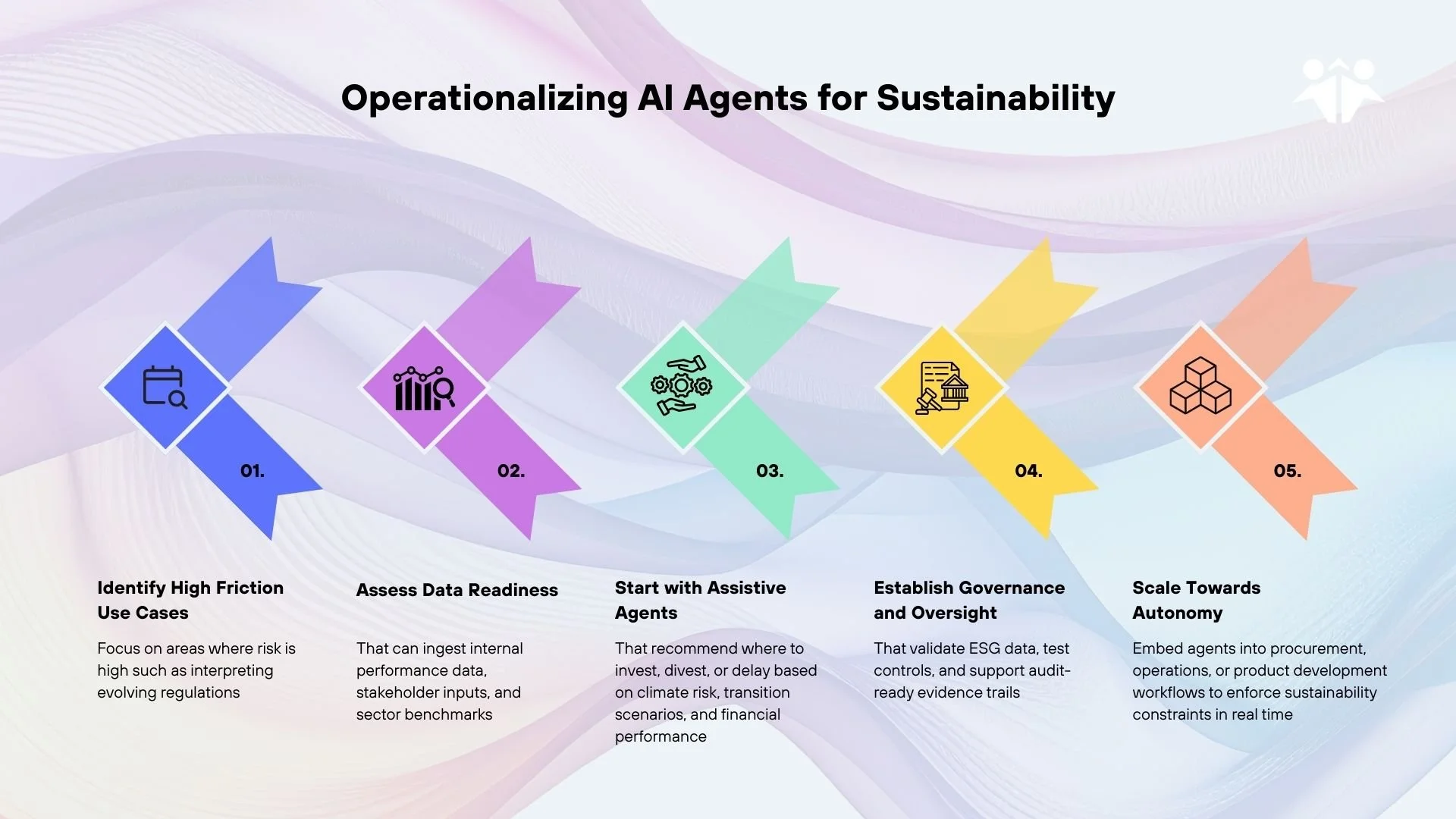
How to Operationalize AI Agents for Sustainability
Closing Perspective
AI agents represent a shift from sustainability teams as data processors to sustainability teams as strategic operators. For leadership, the opportunity is not simply faster reporting or prettier dashboards, it is the ability to embed sustainability intelligence directly into how the organization runs.
Those who adopt early, with strong governance and a clear execution model, will be better positioned to meet those every pressing regulatory demands, growing stakeholder expectations, and long-term decarbonisation goals simultaneously.
Related Reading
Why Sustainability Leaders Need AI Guardrails to Scale Impact Responsibly