Scaling AI for Sustainability: Navigating the “Messy Middle” of AI ESG Implementation
Scaling AI for sustainability often fails in the "Messy Middle,"the volatile gap between pilot success and enterprise deployment. To bridge this, leaders must move from "Mass Experimentation" toward strategic archetypes like "Platform-First" or "Guided" scaling to reduce uncertainty.
This article outlines the Six Readiness Gates, including Performance, Ownership, and Risk, required to move beyond the pilot.
The takeaway: successful AI in ESG is not a finite project, but a "living system" requiring constant adaptation and a continuous improvement mindset to remain effective in a shifting regulatory landscape
Navigating the Messy Middle: Industrializing AI for ESG Excellence
The promise of Artificial Intelligence in the sustainability sector has never been greater, yet many organizations find themselves caught in a frustrating paradox. While 2026 marks a turning point for "Green-AI" and automated ESG reporting, the transition from successful pilot to enterprise-wide scale remains the single most significant hurdle for sustainability leaders.
In the race to achieve Net Zero and satisfy rigorous regulatory requirements, many teams fall into the trap of "Mass Experimentation“ (Why Most AI Pilots Never Scale), a decentralized, let-a-thousand-flowers-bloom-approach that often results in dozens of Proof of Concepts (PoCs) that never actually reach the production line. This creates what we call the "Messy Middle" where uncertainty is high and resource allocation becomes a strategic battlefield.
Moving beyond this middle ground requires value creation through uncertainty reduction. To successfully industrialize AI for sustainability, leaders must shift their mindset from viewing AI as a finite IT project to treating it as a "living system" that requires constant adaptation and rigorous governance.
In this article, we explore the four archetypes of AI experimentation, from Platform-First to Use-Case Led, and introduce the Six Readiness Gates every sustainability leader must clear to ensure their AI solutions are not just innovative, but scalable, responsible, and resilient.
Decoding the Messy Middle: The 4 Archetypes of AI Scaling
In this section, you will discover why the transition from pilot to scale is the most challenging phase of the AI lifecycle. We decode the "Messy Middle" framework to help you identify which of the four scaling archetypes: Guided, Mass, Platform-First, or Use-Case Led, best fits your organization’s ESG goals. You will learn to shift from value-creation to uncertainty reduction, ensuring your experimentation strategy effectively leads to industrial-grade implementation.
Note that this is different from the business readiness approach previously discussed here AI Readiness for Sustainability: How to Assess Business Maturity and Set an AI Strategy, because this is focused on scaling.
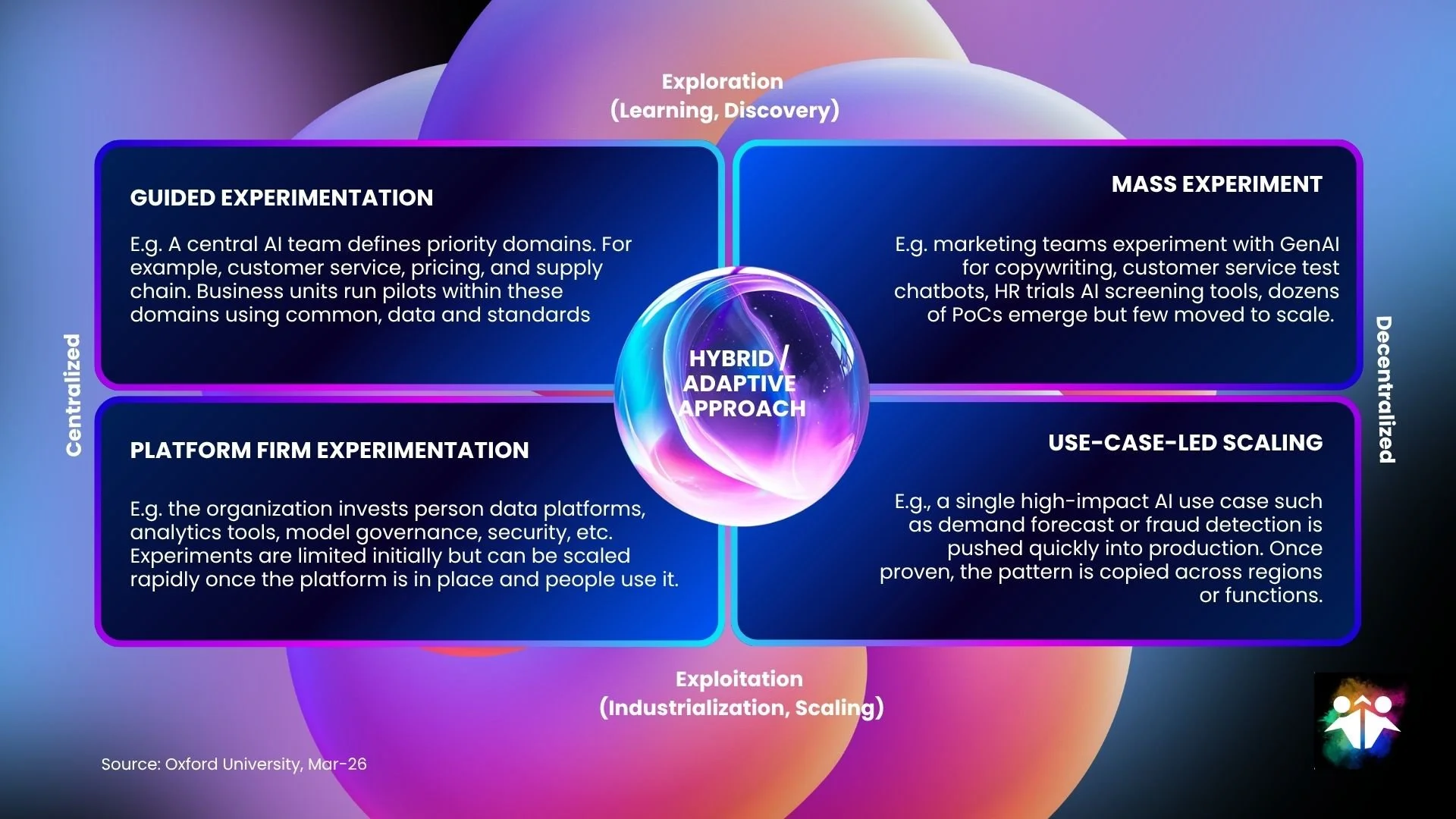
Scaling AI, The Messy Middle (2026), University of Oxford
The "Messy Middle" represents the most volatile phase in the Enterprise AI Development lifecycle, occurring specifically between Stage 5 (Piloting and Testing) and Stage 6 (Deployment at Scale).
Unlike traditional IT projects, navigating this gap is not merely about value creation; it is a strategic exercise in uncertainty reduction through hypothesis testing and learning. As explored in the Oxford Leading AI Implementation Programme, organizations must choose an experimentation archetype based on their placement along two axes: Centralized vs. Decentralized and Exploration vs. Exploitation
As shown in the 2x2 matrix, businesses often find themselves trapped in Mass Experimentation, where decentralized "let a thousand flowers bloom" approaches result in dozens of Proof of Concepts that struggle to reach production. This approach is often challenging because it is hard to control and is inefficient from a resource standpoints. Nor is it considered democratic. On the other hand, it is considered to be democratic, and for it to be valuable to the entire company, there must be a mechanism to collect and communicate lessons learned.
To break this deadlock, leaders can shift toward Guided Experimentation to define priority domains, or a Platform-First approach to invest in the data infrastructure and governance necessary for rapid, industrial-grade scaling. A Platform-First approach tends to be easier to scale because of the governance structures in places and due to a centralised platform that forms the single-source of truth of data.
Lastly, let’s consider the Use-Case Led Approach, which tends to be sequential. While strategic in it’s approach, large firms do not have the luxury of managing AI sequentially, giving pause to the speed of AI implementation.
As of March 2026, most companies are shifting their approach from Guided to Mass Experimentation (Oxford, Said Business School). Ultimately, reaching scale requires moving past isolated "pet projects" to treat AI as a "living system" that demands constant adaptation and sustained organizational commitment.
The Six Readiness Gates: A Checklist for Sustainable AI Industrialization
To scale AI from a experimental "proof of concept" to a core business asset, organizations must navigate more than just technical hurdles. This framework breaks down the transition into six critical readiness gates, designed to ensure that an AI system doesn't just work in a lab, but thrives within the complex ecosystem of a modern enterprise. By evaluating each initiative through these lenses, ranging from core performance and organizational ownership to risk governance and long-term flexibility, leaders can move away from fragmented pilots and toward a unified, industrial-scale AI strategy.
The strength of this checklist lies in its balance between technical execution and human adoption. While gates like Operational and Technical Readiness ensure the plumbing is solid, the Adaptation and Behavioural Readiness gate acknowledges that an AI system is only as valuable as the trust it inspires in its users. By rigorously questioning whether there is sustained business demand, clear accountability, and a "living system" mindset for continual improvement, companies can avoid the "pilot purgatory" that many AI projects fall into. This structured approach provides a defensible roadmap for scaling responsibly, economically, and sustainably.
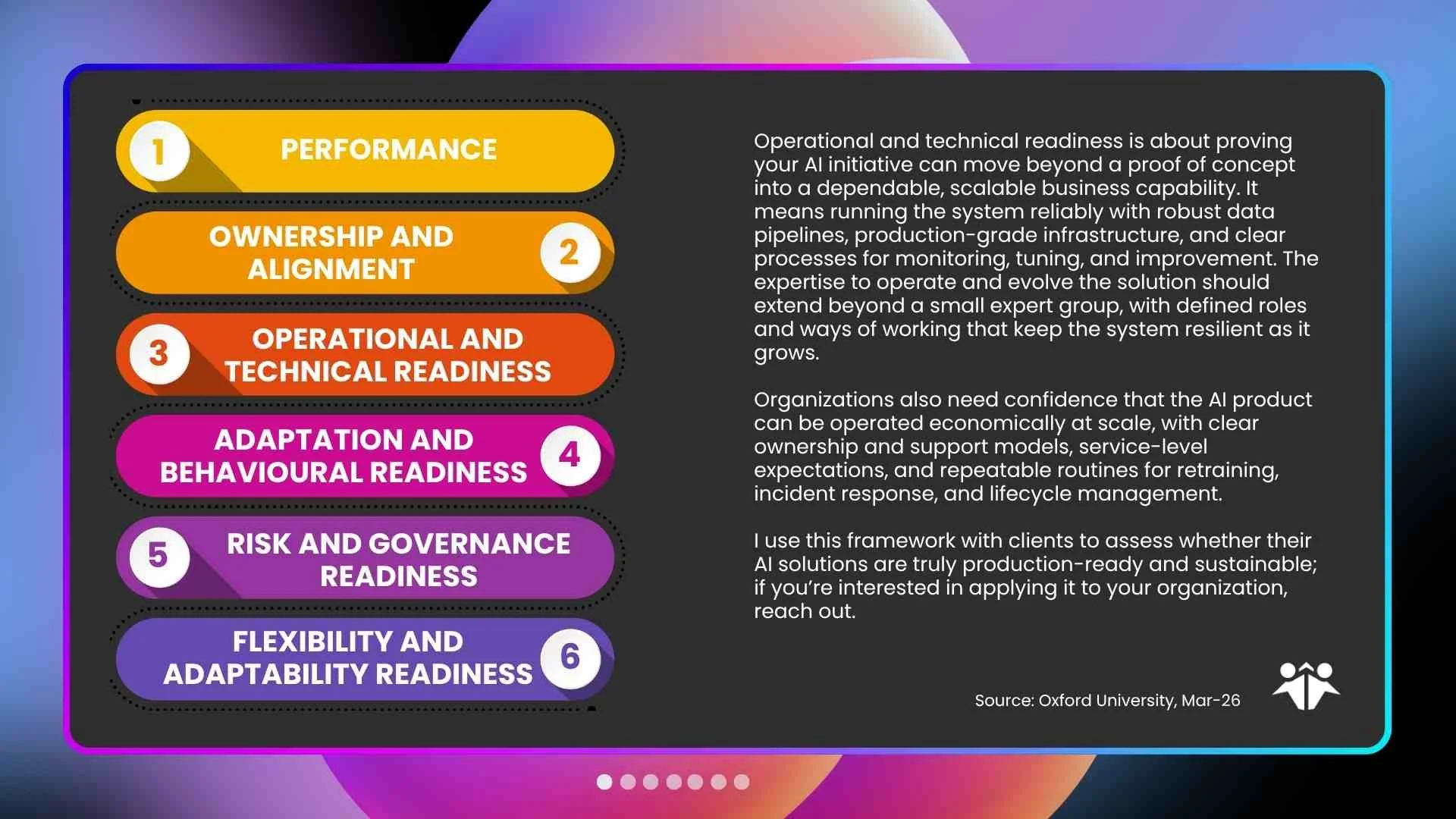
Six Stages of Scaling AI for Sustainability Initiatives
| Gate | Focus | Key Question for Success |
|---|---|---|
| 1 > Performance | Evidence of Value | Has the experiment credibly demonstrated business-relevant performance? |
| 2 > Ownership & Alignment | Organizational Commitment | Is there clear ownership alignment and sustained demand to support this at scale? |
| 3 > Technical & Operations | Reliability at Scale | Can the organization run, maintain, and improve this system economically? |
| 4 > Adaptation & Behavioural | Use, Trust, and Change | Will people trust, use, and act on these outputs in real decisions? |
| 5 > Risk & Governance | Responsible Scaling | Are risks understood, acceptable, and manageable at scale? |
| 6 > Flexibility & Adaptability | Living System Mindset | Is the organization prepared to treat this as an evolving capability? |
To avoid the 'pilot purgatory' where many AI projects fail, companies must build in accountability (Stage Gate 4). Aligning these trust-based metrics with reporting frameworks such as the ISSB sustainability disclosure standards ensures that the system is not just technically sound, but ready for the demands of industrial-grade ESG reporting.
I use this framework with clients to scale their Sustainable AI efforts. If you’re interested in working with me to scale your sustainable AI initiatives, please reach out here.
Conclusion
As of 2026, Industrializing Green AI is a regulatory and operational necessity. To successfully bridge the "Messy Middle," sustainability leaders must transition from a culture of uncoordinated experimentation to a structured, industrial mindset.
By navigating the Six Readiness Gates, organizations can transform isolated pilots into a resilient, "living system" that scales AI for Sustainability with precision. The goal is to move beyond the novelty of the technology and focus on uncertainty reduction, clear ownership, and long-term adaptability. Scaling responsibly today ensures that your ESG initiatives are not just innovative, but built to last in an evolving global landscape.